
The Sacred Stones of the Forest
and how UNESCO is preserving them
Check Nakara Availability NowWelcome to Phu Phra Bat Historical Park, a place where the lines between nature's raw power and human spiritual devotion blur into one breathtaking landscape. Already a beloved treasure of the Northeast, Phu Phra Bat has recently captured the world's attention by being officially inscribed as Udon Thani's second UNESCO World Heritage Site, joining the ranks of the legendary Ban Chiang Archaeological Site. This prestigious designation cements Udon Thani as a global heavyweight in cultural history.
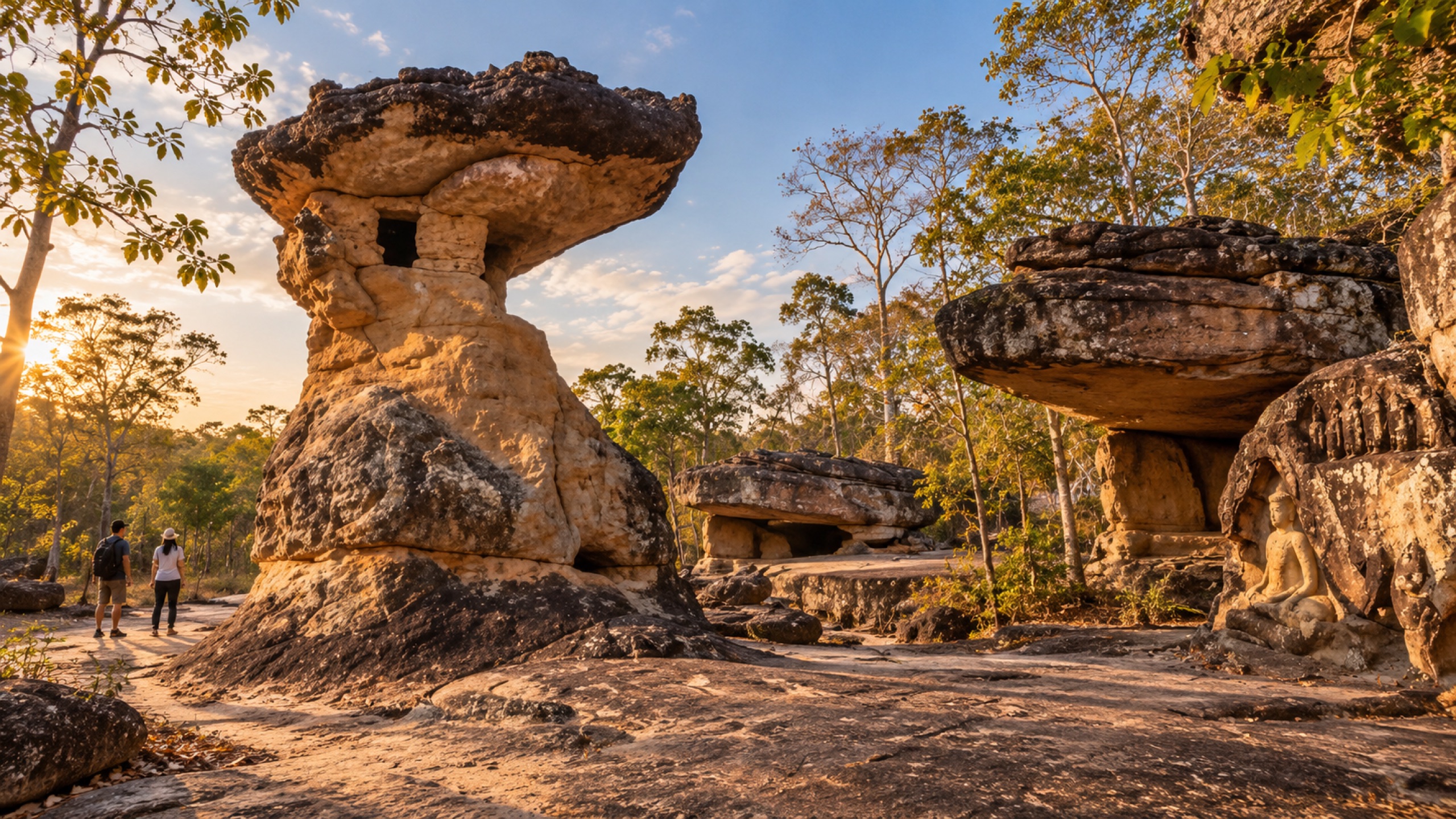
Imagine standing atop a sun-drenched sandstone ridge where gravity-defying boulders balance like giant mushrooms against the Isan sky. Beneath these ancient caps, the walls are alive with crimson ochre paintings of wild cattle and mysterious figures — silent whispers from a civilization that thrived 3,000 years ago. This is not just a park; it is a portal through time.
Whether you are wandering through the Tower of Nang Usa, gazing at the massive Sima stone boundary markers that have stood for a millennium, or simply soaking in the panoramic views that stretch toward the Mekong, Phu Phra Bat promises an experience that is as hauntingly beautiful as it is historically profound.

Sculpted by Time: A Geological Marvel
Before the first human hand ever brushed against these rocks, nature spent millions of years acting as a master architect. The surreal landscape of Phu Phra Bat is a geological wonder that defies common logic; it is a place where massive boulders appear to float on slender pedestals and ancient sea beds have been thrust into the sky.
The story begins approximately 15 million years ago during the Mesozoic Era, when this entire region was part of a vast inland sea. Layer upon layer of sediment settled on the ocean floor, eventually compressing into the thick beds of sandstone we see today. As tectonic plates shifted and the waters receded, the land was pushed upward, creating the rolling plateau of the Phu Phan mountain range.
The park's iconic mushroom-shaped rocks and deep, sheltering overhangs are the result of differential erosion. Over eons, wind, rain and prehistoric water flow ate away at the softer bottom layers of sandstone much faster than the tough, resistant caps. When you stand beneath a formation like Hor Nang Usa, you are standing under a geological masterpiece finished long before the first civilizations rose.

A Portal to the Divine: The Living Spirit of the Rocks
There is a palpable energy at Phu Phra Bat that transcends mere history. For thousands of years, humans haven't just lived here; they have sought the divine here. The ancient inhabitants clearly recognized the gravity-defying shapes and hidden alcoves as a bridge between the earthly and the supernatural.
The silence of the forest is punctuated by the spiritual weight of the Sima stones — massive, hand-carved sandstone slabs used by the Dvaravati people to mark the boundaries of sacred ground. These stones don't just mark a physical space; they mark a transition into the holy.

Even today, the air feels different among the boulders. Local legends suggest the park is guarded by forest spirits, and the presence of Wat Phra Phutthabat Bua Bok (the Temple of the Buddha's Footprint) within the park grounds ensures that the site remains a living center of pilgrimage.

A Tapestry of Civilizations
The history of Phu Phra Bat spans several millennia. The Prehistoric Pioneers (3,000+ years ago) left behind more than 54 groups of rock paintings — in caves like Tham Wua (Cow Cave) and Tham Khon (Human Cave), you can still see vivid depictions of the animals they hunted and the rituals they performed.
The Dvaravati Era (7th–11th century) earned the park its UNESCO status: the Dvaravati people were masters of the Sima stone tradition, and Phu Phra Bat houses the world's largest collection of these stones still in their original positions, some standing over two meters tall. The Khmer Empire followed, adding Hindu-inspired carvings, and later the site became a retreat for forest monks during the Lan Xang era.

The Sacred Significance of the Sima Stone Tradition
The Sima stones represent a profound co-creation between human spirituality and the natural world. Their primary significance lies in their role as boundary markers: in Buddhist tradition, a Sima defines a consecrated space where monks can perform vital rituals, such as ordinations, away from the secular world.
At Phu Phra Bat, ancient people claimed the massive, pre-existing rock shelters as holy sites by surrounding them with upright sandstone slabs — creating the world's most extensive and best-preserved collection of in-situ Sima stones. By placing these stones in eight cardinal directions around natural spires like Ho Nang Usa, ancient builders turned a wild forest into a "spiritual city."

Wat Phra Phutthabat Bua Bok
Dominated by a 40-meter-tall, golden Lao-style chedi modeled after the iconic Phra That Phanom, this temple serves as the sacred heart of the region. Built in 1920 to protect a natural sandstone depression believed to be a Buddha footprint, the site is steeped in local Naga legends.
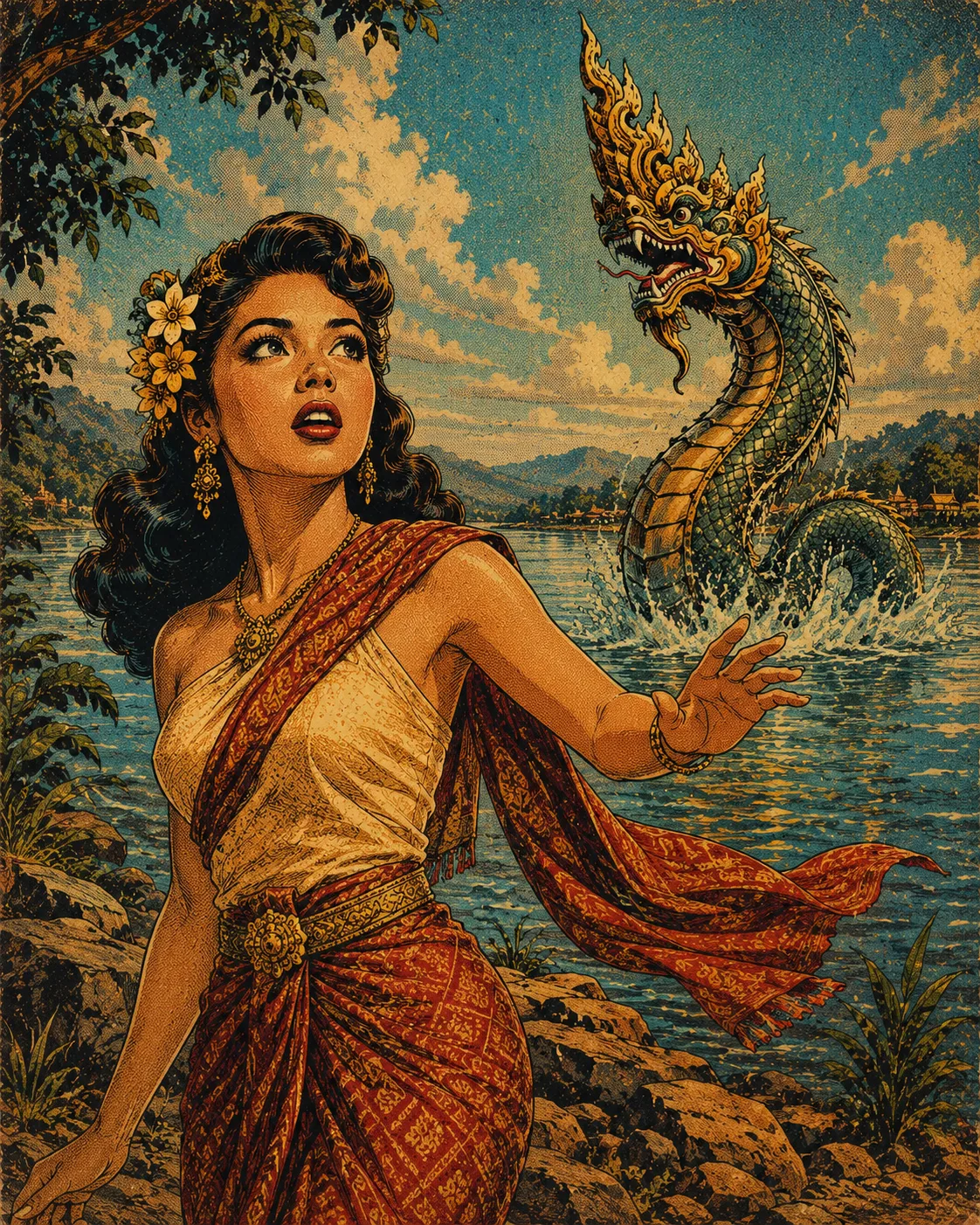
The Bua Bok legend tells of the fierce Naga King, Milinthanak, who was tamed by the Buddha's compassion. Unable to be ordained as a monk, the Naga requested a sacred token — the Buddha pressed his footprint into the sandstone, creating a spiritual anchor that remains the mountain's holiest site today.

Myths and Legends: The Tragic Tale of Nang Usa
While the archaeology of the park is fascinating, its soul lies in the folklore that gives names to its most famous rocks. The most enduring legend is the story of Nang Usa and Tao Barot, a romantic tragedy that locals have whispered for generations.
Long before Phu Phrabat became a historical park, a small kingdom near present-day Nong Khai was ruled by King Phaya Kong Phan — a just and honorable ruler whose queen bore him no children. High in the remote mountains of Phu Phrabat, a baby girl was born from a lotus flower beside a forest pool. She was discovered by Ruesi Chanta, a wise hermit, who named the child Usa, meaning "First Light of Dawn," and raised her in seclusion.

One day, fate carried the king into the mountains, where he saw the child and was immediately taken by her radiance. The hermit warned him: if the girl were raised as a princess and later married, her husband would one day be the cause of the king's death. But the king's longing for an heir overcame his fear, and he brought the child to the palace.
Usa grew into a beloved princess. When suitors began to notice her, the king's fear returned. To protect himself, he sent her back to the mountains under the pretense of study, confining her to a small chamber carved into a towering stone pillar, now known as Hor Nang Usa.

Lonely and longing for her destined partner, Nang Usa floated a flower garland down the stream where she bathed, trusting fate to guide it. Far downstream in the Mekong, the garland was found by Prince Tao Barot, who followed the stream upstream into the mountains through the night, ending among the strange rock formations of Phu Phrabat, where his horse was tied beneath a stone now called Barot's Stable.

At dawn, Tao Barot saw Nang Usa in the first light of morning and fell instantly in love. When Ruesi Chanta discovered them together, he summoned the king to prevent bloodshed. Rather than fight, the king's advisers proposed a sacred contest: before the morning star rose, each side would build a Buddhist temple, and the winner would claim Nang Usa.
The king built in the valley with many workers and abundant materials. Tao Barot chose the mountaintop, using an overhanging rock as a roof. Deep into the night, realizing he would lose, the prince climbed a tree and raised his lantern high, tricking the king's workers into believing the morning star had already risen. They stopped work, and Tao Barot finished his simple temple just in time.

When the true morning star appeared, the king's temple stood incomplete. Bound by the rules he had accepted, the king was executed and his head thrown from Pha Sadet cliff. The prophecy had been fulfilled.

Tao Barot returned to his palace with Nang Usa, but his triumph had come through deception, and that stain followed him. At court, Nang Usa was treated cruelly by noblewomen who had hoped to marry the prince, and Tao Barot began to distance himself, tempted by palace life. When the truth of his deception at Phu Phrabat emerged, the court astrologers declared that Tao Barot must wander the wilderness for a year to cleanse his karma.
Left alone and betrayed, Nang Usa fell into deep sorrow and returned to her tower. Her grief became illness. When Ruesi Chanta summoned Tao Barot, the prince abandoned his penance and rushed to her side, but arrived too late — Nang Usa died before dawn. Heartbroken, Tao Barot died soon after. The rocks near Hor Nang Usa are said to mark their graves, standing side by side for eternity. Legend says the two were later reborn as Indra and Indrani, reunited at last beyond the reach of prophecy, pride and betrayal.

Touring Phu Phra Bat
Phu Phra Bat is located in the Ban Phue District, nestled within the lush greenery of the Phu Phan Mountains. It is an easy and scenic day trip from Udon Thani, with a network of modern paths and stairs allowing visitors to comfortably explore the UNESCO-listed rock shelters and forest scenery without the need for intense climbing.

Quick Facts
UNESCO Status
Inscribed in July 2024 as Thailand's 8th World Heritage Site
Entrance Fee
100–150 THB for Foreigners / 20–30 THB for Thais
Opening Hours
08:30 AM – 04:30 PM (Daily)
Electric Shuttle
100 THB per trip (Seats 4-5 people). Covers about 50% of the main route
Guided Tours
Available at the Visitor Center (Free, but tipping is expected)
Walking Difficulty
Easy to Moderate. Modern wooden walkways cover most major sites
Distance from Udon
Approx. 65 km (1 hour drive) from Udon Thani city
Best Time to Visit
08:30 AM (to beat the heat and catch the best morning light)
Why Stay at Nakara Villas & Glamping for Your Phu Phra Bat Trip?
Nakara Villas & Glamping is a peaceful base for exploring Phu Phra Bat Historical Park, with plenty of space to relax after a day among its extraordinary rock formations, ancient sacred sites and prehistoric landscapes. A visit to Phu Phra Bat also combines beautifully with Wat Pa Phu Kon, Udon Thani’s spectacular Blue Temple, allowing you to experience two completely different sides of the province in one memorable day. Explore the ancient landscape of Phu Phra Bat, continue through the hills to Wat Pa Phu Kon, then return to Nakara for a swim, dinner and a quiet evening in the gardens.
Getting to Phu Phra Bat
By private car: from Udon Thani city center, head north on Highway 2 toward Nong Khai for 13 km, then turn left onto Route 2021. Follow this for 50 km to Ban Phue and follow the signs.
By Nakara Villas Private Tour: for the most comfortable and stress-free experience, we can organize a private car or a spacious, air-conditioned van for you. Private tours start from 1,500 THB.
An electric buggy/shuttle service is available at the Tourist Information Center, typically costing around 100 baht per trip (up to 4-5 people). The buggy is restricted to paved paths covering roughly half of the main route — some walking on natural trails is still required to see the more remote rock formations and prehistoric paintings.
Pro Tips
Wat Phra Phutthabat Bua Bok is 2km from the main site, so avoid walking there in midday summer heat. Sturdy walking shoes are essential for the forest trails, along with a hat and water. Cell reception can be spotty, so download an offline map before you go. Combine your visit with a trip to the breathtaking Blue Temple (Wat Pa Phu Kon).