
Sala Keoku, a Unique Park Based on One Man's Vision
There are places you visit to see something beautiful.
There are places you visit to learn something.
And then there are places like Sala Keoku, where you can arrive expecting to photograph some enormous and wonderfully strange statues and leave two hours later thinking about your own life.
That probably sounds rather serious.
Sala Keoku isn't.
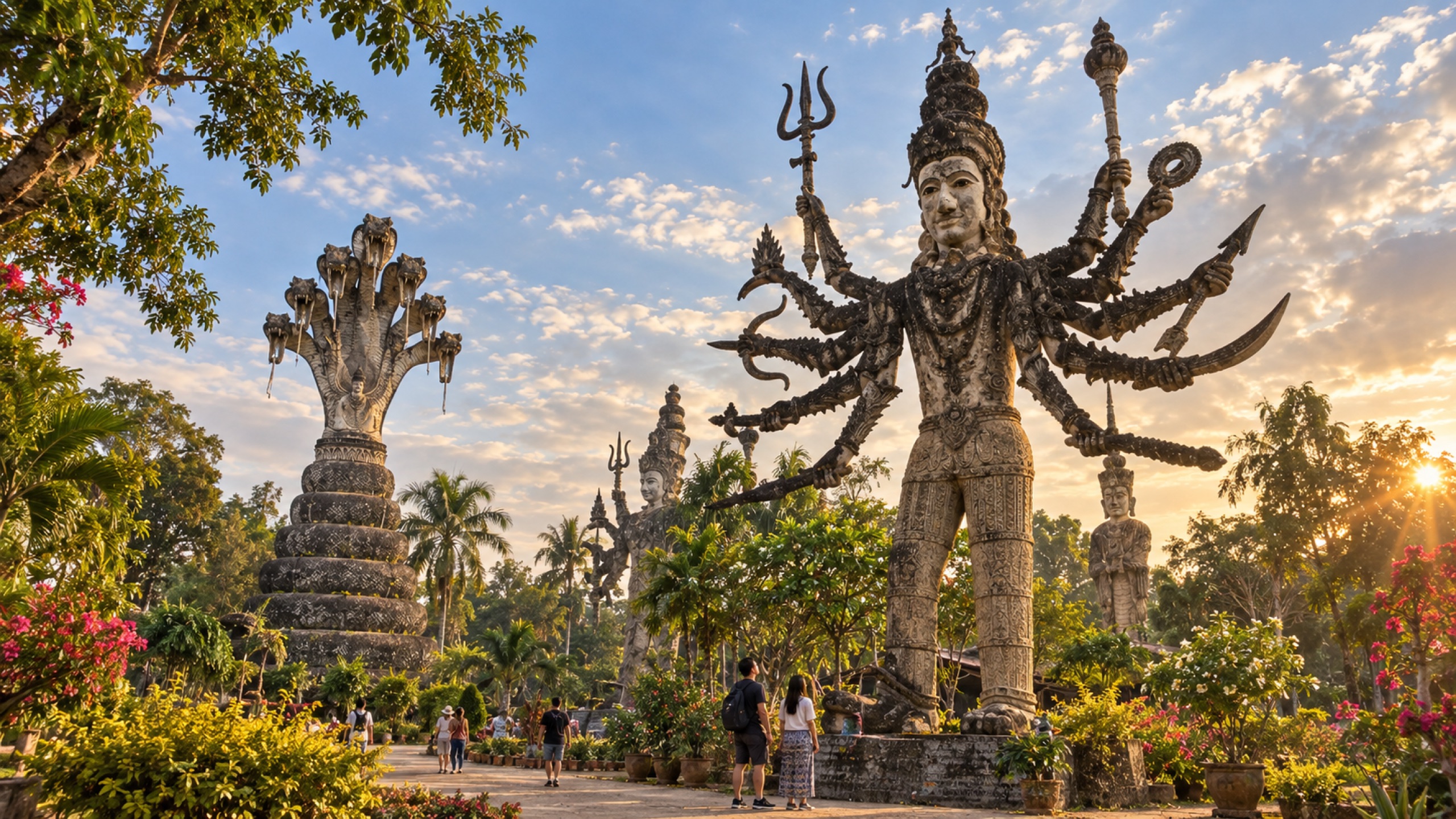
It is enormous, eccentric, sometimes bewildering and often great fun. Giant Nagas rise above the trees. Hindu deities stretch multiple arms into the sky. Buddhas sit alongside demons, animals, skeletons and strange scenes that can look as though they escaped from somebody's dream.
Some sculptures are beautiful.
Some are unsettling.
Some may leave you with absolutely no idea what you have just looked at.
That is part of the experience.
But Sala Keoku becomes much more interesting when you realise that these sculptures were not created simply to impress you.
They are trying to tell you something.
And beneath all of it runs an idea that becomes increasingly difficult to ignore: we may make choices about our lives, but we live inside forces much larger than our individual will.
Time moves whether we want it to or not.
Bodies age.
Other people affect us.
Desire pulls us in different directions.
Actions have consequences.
Circumstances change.
Eventually, every life ends.
Whether you interpret those forces as karma, nature, chance, society, spirituality or simply the reality of being human is up to you.
That is what makes Sala Keoku interesting even if you are not religious.
You do not have to believe everything it says.
You simply have to allow it to ask the questions.
Sala Keoku contains more than a hundred monumental sculptures, with Buddha images, Hindu deities, Nagas, animals, demons, human figures and moral allegories spread throughout the grounds. Construction began in 1978 under the direction of mystic and spiritual teacher Bunleua Sulilat. Some works reach approximately 25 metres in height.
And the more you know about the man who imagined it, the stranger and more fascinating the place becomes.
Bunleua Sulilat: The Man Behind Sala Keoku
Bunleua Sulilat was not a conventional monk.
He was variously described as a mystic, spiritual teacher, myth-maker, sculptor and religious leader whose beliefs drew on Buddhism, Hinduism and local spiritual traditions.
Most biographical accounts place his birth in Nong Khai province in 1932, but much of his early spiritual life unfolded across the Mekong in Laos. His life belonged to the old cross-border cultural world of the Mekong far more naturally than it fits into a modern national boundary.
And then there is the cave.
The Strange Legend of the Cave
According to the story repeated by Sulilat's followers and later accounts of his life, the young Bunleua accidentally fell into a cave or deep hole.
Down there he encountered a mysterious hermit named Keoku, or Kaew Ku.
It is important not to turn the legend into something more definite than it is. Most accounts describe Keoku as a hermit or spiritual master rather than literally a god.
But within Sulilat's story, the encounter changed everything.
Keoku supposedly taught him spiritual knowledge and introduced him to ideas that would later become part of Sulilat's extraordinary personal philosophy. The name Sala Keoku itself is generally understood as the Hall or Pavilion of Keoku, preserving the name of this legendary teacher.
Some accounts also describe Sulilat later studying with a Hindu rishi in Vietnam, adding further Hindu influence to a worldview already shaped by Buddhism, folklore and the religious culture of the Mekong.
How much of the cave story is literal history and how much became part of the mythology surrounding Sulilat is impossible to establish with certainty.
Perhaps that is appropriate.
Almost everything about Sala Keoku occupies the space between religion, philosophy, folklore and imagination.

Before Sala Keoku There Was Another Park
Sulilat first became prominent in Laos.
In 1958, he began creating a vast sculpture garden outside Vientiane, today generally known as Buddha Park or Xieng Khuan.
There he began doing something that would define his life: taking abstract spiritual ideas and turning them into enormous physical objects that ordinary people could walk around, touch, examine and discuss.
Following the political upheaval and communist takeover of Laos around 1975, Sulilat left Laos and crossed the Mekong into Thailand.
A few years later, in 1978, construction began on his second and even more ambitious sculpture park near Nong Khai.
Sala Keoku had begun.
How Did They Build Sala Keoku?

This becomes one of the great questions when you actually stand underneath the sculptures.
How did anyone build these things?
Sala Keoku was not produced by a modern architectural practice using computer modelling and a specialist sculpture contractor.
The huge figures were built principally from reinforced concrete, with brick and internal supporting structures used in the construction of the works. Sulilat conceived and directed the sculptures, while many of the people actually helping him were devotees and followers rather than formally trained sculptors.
Local accounts describe donated materials and followers contributing their labour to Sulilat's vision. Sulilat himself reportedly claimed that his helpers' abilities came not from conventional artistic training but from a spiritual source.
Whether you accept that explanation or not, the physical achievement is remarkable.
Some sculptures rise seven storeys or more above the ground.
Look closely and they do not have the polished precision of something manufactured by a modern entertainment company.
They are handmade.
Weathered.
Occasionally imperfect.
Sometimes almost impossibly ambitious.
That roughness is part of their power.
You can see human hands in them.
The Final Years of Sulilat
Sulilat continued overseeing Sala Keoku for the rest of his life.
Accounts say that as his health deteriorated his followers would move him around the park so he could continue directing their work. One story says a fall while working around one of the giant sculptures preceded his declining health, although the precise connection between the accident and his eventual death is uncertain.
He died in 1996.
But the story does not quite end there.
His preserved body remains at Sala Keoku.
We will come back to him.
First, walk into the garden he created.
What Should You Look For at Sala Keoku?
Trying to understand every sculpture would be almost impossible.
There are simply too many.
And you do not need to.
Instead, there are several works that unlock different parts of Sulilat's world.
Start with the most important of all.
1. The Circle of Life
If Sala Keoku is an epic poem about human existence, the Circle of Life is the chapter in which Sulilat explains the plot.
It is not simply one statue.
It is a large circular installation that you physically enter.
And you enter it in one of the strangest ways imaginable.
Entering Life

The entrance is formed as a huge open mouth leading into a narrow tunnel.
It is commonly interpreted as a womb or passage into human existence.
You crouch or walk through it.
Then you emerge inside.
In other words, Sulilat does not simply show you birth.
He makes you enter his story through it.
From there, figures positioned around the circular installation depict human existence progressing through different experiences.
Different guides divide the sequence slightly differently, but the broad journey is remarkably consistent: conception and birth lead into desire and youth, relationships and marriage, difficulties and choices, ageing and suffering, and eventually death.
Desire, Love and Becoming Someone
After birth comes life.
Identity forms.
Desire appears.
We begin wanting things.
We form relationships.
We imagine what our lives should become.
And eventually there is partnership and marriage.
Several figures inside the Circle depict recognisably ordinary human relationships.
This is important.
For all Sala Keoku's enormous deities and mythical monsters, some of Sulilat's most interesting observations concern completely everyday human behaviour.
Love somebody.
Choose somebody.
Build a life.
Make decisions.
Discover that choices have consequences.
Mistakes, Hardship and Consequences
The Circle becomes more complicated as life progresses.
Different paths imply betrayal, disappointment, hardship, regret and reconciliation.
One modern account describes an elderly couple regretting an earlier decision not to have children, an example of Sulilat's broader idea that decisions made early in life can echo decades later.
You do not have to accept Sulilat's judgement about any particular choice.
That is important.
The interesting idea is larger: we make decisions without knowing the people we will eventually become.
Only later do we discover what those decisions meant.
That is philosophy rather than sightseeing.
Ageing
Eventually youth disappears.
One figure depicts an elderly person bent forward, supported by a walking stick.
There is no attempt to make ageing heroic or picturesque.
The body simply becomes weaker.
Sulilat places ageing alongside suffering and change as unavoidable elements of human existence.
It is difficult to look at that sculpture without recognising somebody.
A parent.
A grandparent.
Perhaps eventually yourself.
Death
And then come the skeletons.
The body reaches its destination.
The Circle of Life has moved from conception to death.
But within Buddhist thought, that does not necessarily mean the journey is finished.
The problem is the circle itself.
Can You Leave the Circle?

The final idea is perhaps the most important.
The installation ends with figures moving beyond the boundary of the Circle towards Buddha.
Sources describing the work interpret this as escaping the recurring cycle of birth and death through enlightenment, Nirvana.
There is even an almost physical invitation to step beyond the boundary.
Life goes round.
Unless somehow you find a way out.
And at the centre of the installation stands the extraordinary multi-faced figure you have seen in photographs.
One recent guide interprets it as a reminder that higher forces remain while individual human lives pass around them. That interpretation fits the architecture of the work particularly well, although I would treat it as an interpretation rather than pretend there is one universally authoritative English explanation of every symbol.
Perhaps that uncertainty is part of the attraction.
You are allowed to think for yourself.
2. Buddha Beneath the Seven-Headed Naga

Then there is the sculpture that perhaps best communicates the sheer scale of Sala Keoku.
A seated Buddha rests beneath the protection of an enormous seven-headed Naga.
The work rises to around 25 metres, making it one of the park's largest sculptures.
The imagery comes from the Buddhist story of Mucalinda, the serpent king who protects the meditating Buddha during a storm after his enlightenment.
Mucalinda coils around the Buddha and spreads his multiple heads overhead as shelter.
Sulilat takes that familiar religious image and turns the scale almost absurdly high.
Stand beneath it and something interesting happens.
The Naga is huge.
The world appears threatening.
Yet Buddha remains still.
Perhaps this is another version of the message running throughout Sala Keoku: we cannot always control what surrounds us, but perhaps we can control how we meet it.
And here in Nong Khai, beside the Mekong, the Naga carries an additional resonance.
This is a landscape where serpent legends are still deeply embedded in local culture.
At Sala Keoku, mythology does not feel very far away.
3. The Giant Multi-Armed Deities

Some of Sala Keoku's most spectacular figures possess a bewildering number of arms.
Each hand may hold a weapon, staff, disc, ritual object or other symbol.
They are immediately reminiscent of the Hindu divine world, and the park contains imagery connected with Shiva, Vishnu, Brahma and other figures alongside Buddhist traditions.
But there is a useful lesson here for visitors.
Do not assume you can identify every figure from appearance alone.
Sulilat blended traditions freely, and English-language identifications of individual statues are sometimes inconsistent.
Better to look first.
Notice the multiplicity of arms.
The different objects.
The extraordinary size.
The serene face above all that activity.
Again, human scale seems tiny beside something vastly more powerful.
Perhaps that is precisely how Sulilat intended it to feel.
4. The Elephant and the Barking Dogs

Not everything at Sala Keoku concerns cosmic questions.
Some sculptures are much closer to folk wisdom.
One depicts an elephant surrounded by barking dogs.
The image refers to a proverb about continuing on your path regardless of criticism and noise around you.
The dogs can bark.
The elephant keeps walking.
It may be one of the easiest sculptures in the park for any visitor to understand.
And perhaps one of the most useful.
Two thousand years of philosophy compressed into something your grandmother might have told you: not every voice deserves your attention.
5. Prince Siddhartha Leaves His Palace

Among the park's more recognisably Buddhist narrative scenes is the story of Prince Siddhartha leaving his palace, the event traditionally known as the Great Departure.
Before becoming Buddha, Siddhartha lived a protected royal life.
Then he encountered sickness, ageing and death and realised that privilege could not protect anyone indefinitely from the fundamental conditions of human existence.
He left the palace in search of an answer.
Sala Keoku includes a sculptural representation of Siddhartha's departure on horseback, accompanied by divine figures.
It belongs perfectly here.
Because it asks essentially the same question as the Circle of Life: once you recognise suffering and mortality, what are you going to do about it?
The Pavilion: And Finally, Meet Sulilat Again

After all the giant sculptures outside, the main pavilion can initially seem like a completely different experience.
It is a three-storey structure, and sources indicate that the building was completed after Sulilat's death following his plans.
Inside are religious objects, displays and material connected with Sulilat and his movement.
Then you reach the upper floor.
And there he is.
Bunleua Sulilat's preserved body lies inside a shrine beneath a glass covering.
Written down, that sounds macabre.
After walking through Sala Keoku, it can feel strangely appropriate.
This is the man who spent decades making enormous sculptures about desire, suffering, ageing, death and escaping the cycle of existence.
Now his own body has become part of the experience.
You have walked through his philosophy.
Then you meet its author after his death.
The sculptures remain outside.
Sulilat's body remains here.
But the person who conceived all of it is gone.
Perhaps there is no need to explain the moment further.
Sala Keoku has already spent the afternoon asking you what lasts.
Is Sala Keoku Religious?
Yes.
And no.
Its vocabulary is unquestionably religious.
Buddha.
Nagas.
Hindu gods.
Karma.
Rebirth.
Nirvana.
Mythological creatures.
But Sala Keoku does not feel like reading a religious textbook.
It feels more like poetry and philosophy expressed through religious imagery.
You can be Buddhist and find meaning here.
You can be Hindu and recognise ancient imagery.
You can have no religious belief whatsoever and still find yourself thinking about love, regret, ageing, time and death.
That is why we think the best preparation for visiting Sala Keoku is not memorising the names of gods.
It is simply arriving ready to look.
Visiting Sala Keoku
Sala Keoku is on the eastern side of Nong Khai, only a few kilometres from the city centre and close to the Mekong.
From Udon Thani, the road distance is roughly 55–57 km, with driving typically taking around 50 minutes to an hour depending on your starting point and traffic.
A car is the easiest option from Udon Thani.
If you are already staying in Nong Khai, tuk-tuks, taxis and rented motorcycles are practical ways of reaching the park.
Allow at least 90 minutes, and preferably closer to two hours if you genuinely want to look at the sculptures and read rather than simply photograph the largest ones.
Morning and later afternoon are generally more pleasant because much of the park is outdoors.
Current 2026 visitor information commonly lists an entrance charge of around 20 THB for Thai adults, 10 THB for children and around 40 THB for foreign visitors. Published opening hours vary slightly between sources, with 8:00 AM to 6:00 PM commonly reported, while some local listings show the outdoor grounds opening earlier. The third-floor Sulilat shrine may close before the grounds, so check locally before making a special journey late in the day.
Make Sala Keoku Part of a Nong Khai Day
Sala Keoku should not necessarily be the only reason you drive north.
Combine it with Wat Pho Chai, Tha Sadet Market, the Nong Khai riverfront and lunch or dinner beside the Mekong.
That creates a much richer day.
The sculpture park gives you Sulilat's highly personal interpretation of the spiritual world.
Nong Khai itself gives you the culture and landscape from which many of those ideas emerged.
And running through everything is the Mekong.
Why Nakara Villas & Glamping Is a Great Base for Sala Keoku
We are not the closest accommodation to Sala Keoku.
We would rather be honest about that.
What Nakara Villas & Glamping offers is a peaceful base from which you can explore much more than one attraction.
From Udon Thani, Sala Keoku is an easy day trip. That means you can spend the day exploring Nong Khai, visit the sculpture park properly, walk beside the Mekong, eat somewhere by the river and then return to the gardens, pool and peace of Nakara rather than changing hotels simply to move another hour north.
We have spent years helping visitors explore this part of Isan.
Whether you want a quick visit to Sala Keoku or a full Nong Khai day including temples, markets, food and the Mekong, we are happy to help you work out a route that makes sense.
Because Sala Keoku is one of those attractions where knowing what you are looking at makes the experience far better.
Hopefully this guide has already started that journey.
