
How a Toad Prince Defeated Heaven and Brought Back the Rain
Long before rockets screamed into the skies above Isan, before roads crossed the rice fields and before anyone could look at a weather app and confidently announce that it might rain at four o'clock, the people of the Mekong lands understood one very simple truth: without rain, nothing mattered. Rice could not grow. Rivers shrank. Buffalo weakened. The earth cracked beneath the sun and entire communities could only look towards the sky and wait.
And somewhere above that sky, according to an ancient legend, lived the being responsible for all of it. His name was Phaya Thaen, ruler of the heavens and master of the rains. Unfortunately, Phaya Thaen had an ego. And this is the story of what happened when one very unlikely king decided that everybody had put up with it for long enough.
The Prince Who Looked Like a Toad
There was once a prosperous kingdom ruled by a good king and queen. For many years they had no child. Then at last the queen became pregnant, and astrologers predicted that the child would possess extraordinary merit. Then the baby arrived — and he looked like a toad. His skin was rough and mottled, his body squat.
The king did not reject him. He looked at his strange little son, recognised the golden colour of his skin, and declared him Khankhak, the Toad Prince. The prince grew up within the palace and showed all the qualities the astrologers had predicted — intelligent, thoughtful and compassionate. But being virtuous did not make being a toad particularly convenient. When Khankhak reached adulthood, he told his father he wished to marry a beautiful princess and have a magnificent palace. His father loved him, but finding a princess willing to marry a man who looked like an enormous toad might be difficult.
Khankhak returned to his rooms disappointed, but he did not give up. He prayed. In many tellings, his devotion and accumulated merit reached the heavens, and the gods recognised that beneath the strange exterior was someone worthy of far more than the world expected of him. During the night the extraordinary happened: Khankhak's rough skin disappeared.

A magnificent palace appeared, glittering with treasures, and beside him was a beautiful woman, often named Nang Kaew-Udon, destined to become his wife and queen. The king eventually surrendered the throne. The Toad Prince became Phaya Khankhak, the Toad King. And he proved to be an exceptional ruler.
A King Everyone Loved
Phaya Khankhak governed with kindness. His queen established places where the poor could receive food. The king listened to the troubles of ordinary people. His reputation travelled far beyond the walls of his own city — people came to honour him, then animals came, then creatures from forests, rivers and fields. Even beings from the spiritual world were said to have travelled to his kingdom to hear him speak.
High above the earth sat Phaya Thaen, accustomed to receiving respect. But increasingly everyone seemed to be talking about Phaya Khankhak instead. People praised the Toad King. Animals praised the Toad King. Heavenly beings praised the Toad King. And Phaya Thaen became jealous. He decided to remind the earth exactly who was in charge. He stopped the rain.
Seven Years Without Rain
At first people waited. A few clouds appeared and disappeared. The planting season came but the rains did not. Another season came. Still nothing. The ponds began shrinking, streams disappeared, forests became dry enough to burn, crops failed. According to one of the best known versions of the legend, the drought lasted seven years, seven months and seven days. The number is almost certainly the language of legend rather than meteorological record, but its meaning is unmistakable: this was catastrophe.

Eventually the surviving people and animals went to Phaya Khankhak and begged their king for help. The Toad King discovered that the drought was not natural — Phaya Thaen had deliberately prevented the rains because he was angry that the people of earth no longer showed him sufficient respect. Phaya Khankhak attempted to resolve the problem, but Phaya Thaen would not listen. So earth declared war on heaven.
The Naga Goes to War
The first great champion to step forward was Phaya Naga, the mighty serpent king. If anybody could confront the ruler of the heavens, surely it was the Naga. Phaya Naga gathered his forces and attacked. It did not go well — Phaya Thaen controlled the sky, and fighting him in his own kingdom was almost impossible. The Naga army was defeated and forced back to earth. Other creatures tried. They failed as well. Phaya Thaen possessed greater raw power. So Phaya Khankhak stopped thinking about strength, and started thinking about strategy.
The Army of the Small
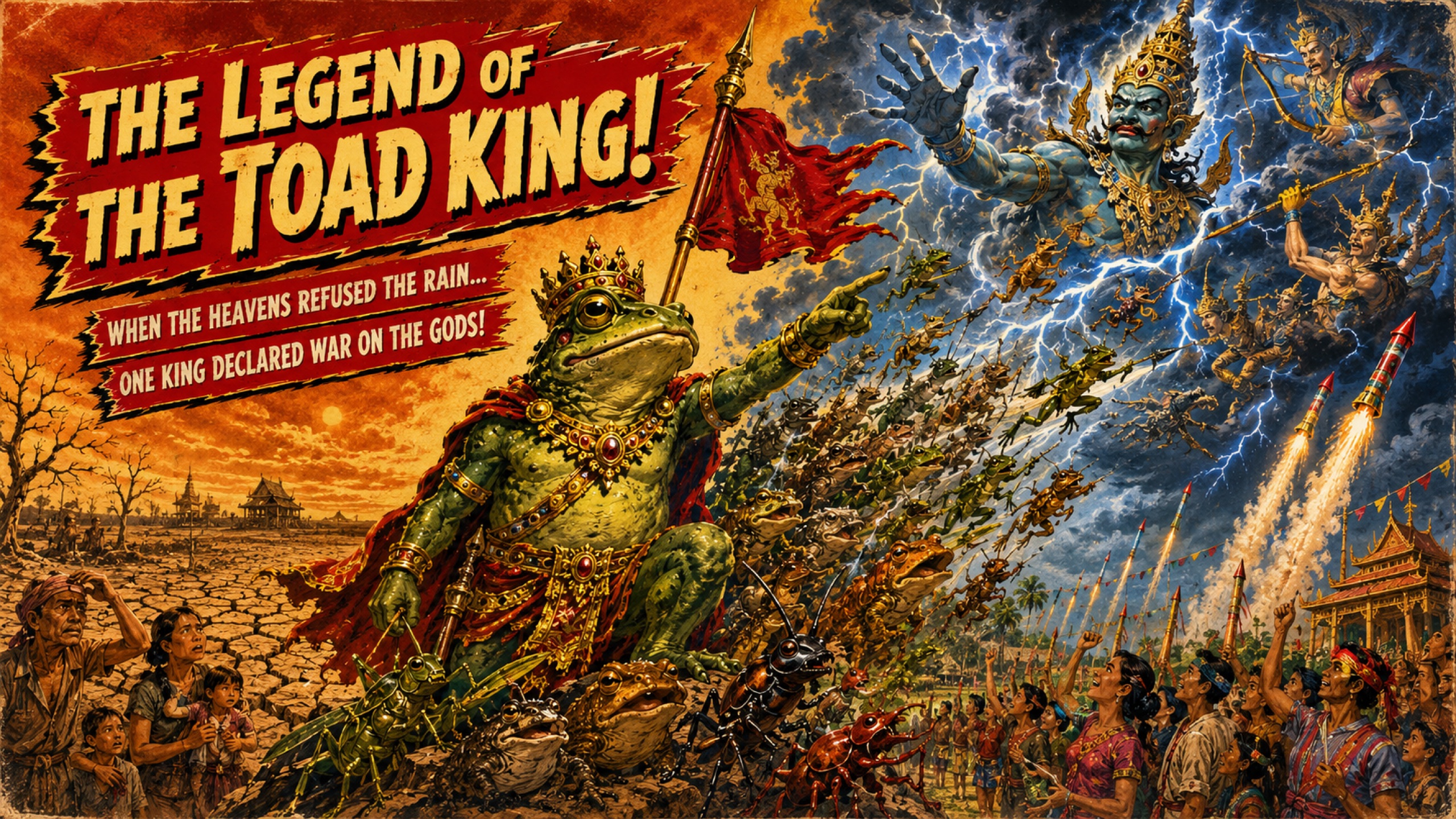
Phaya Khankhak called together the creatures of the earth — not simply the largest or strongest, but everyone. Humans came. Animals came. Insects came. Termites, scorpions, centipedes, hornets, bees, frogs, snakes and countless other creatures gathered behind the Toad King, and every creature was given a job.
The termites were particularly important. While Phaya Thaen prepared for another conventional battle, the termites quietly went to work — in some versions constructing an enormous pathway towards heaven, in others infiltrating the enemy's weapons and eating the wooden handles of swords and spears. The scorpions and centipedes crept into the places where Phaya Thaen's soldiers slept and hid among their clothing. When the heavenly soldiers dressed for battle, they were bitten and stung. Hornets and bees attacked from the air. The weapons Phaya Thaen's troops reached for began falling apart in their hands.

Then the main army attacked. Suddenly the celestial forces found themselves fighting enemies above them, beneath them and inside their own clothes. It was chaos. Phaya Thaen had expected a contest of power. Phaya Khankhak had given him a masterclass in asymmetric warfare conducted largely by insects. The armies of heaven collapsed. The Toad King's forces advanced. Eventually Phaya Thaen himself was captured. The ruler of the sky had been defeated — by a toad, and some termites.
The Agreement Between Earth and Heaven
Phaya Khankhak could have destroyed his enemy. He did not. This was never really a story about replacing one powerful ruler with another — the people did not need ownership of heaven, they needed rain. So the Toad King negotiated. Phaya Thaen agreed that he would once again send seasonal rains to earth. But the two sides needed a system, so signals were agreed.
When the people needed the rainy season to begin, they would send rockets into the sky, climbing towards the heavens as a reminder: it is time, send the rain. When the rains arrived, the frogs would call from the flooded fields and ponds, telling Phaya Thaen the water had reached the earth and the planting season could begin. And when the harvest approached, another signal would be sent — in some traditions, large kites carrying bows or humming strings were flown into the seasonal winds, telling heaven: enough, you can stop now.
And so balance returned. Clouds gathered. Rain fell. Rivers filled. Rice returned to the fields. Frogs emerged and called into the darkness. Life began again.
Why Isan Still Fires Rockets at the Sky
And this is where an ancient story suddenly becomes part of modern Isan. Every year, as the dry season reaches its end and communities prepare for the arrival of the monsoon, enormous homemade rockets are carried through towns and villages across northeastern Thailand and Laos. This is Bun Bang Fai, the Rocket Festival — Buddhist merit making, music, dancing, parades, food, drinking and the particular variety of organised chaos at which Isan festivals excel.

Today Bun Bang Fai is both ancient ritual and enormous celebration — Yasothon has become particularly famous for it, with spectacular rockets and huge crowds. But beneath the noise, smoke and fun remains one of the oldest concerns of the people who have lived on this land: rain. Too little rain can destroy a crop. Too much can destroy it as well. The timing matters, and the relationship between people, land, water and weather has shaped not only agriculture but belief, ritual and storytelling.
The Hero Nobody Expected
Phaya Khankhak remains such a wonderful Isan hero because he begins the story as the least likely hero imaginable — a prince born looking like a toad, underestimated because of his appearance. He becomes powerful not through cruelty but through merit, generosity and wisdom. And when disaster comes, he does not wait passively for somebody more impressive to rescue everyone. He takes responsibility, and understands something his stronger allies initially do not: you do not have to fight on your enemy's terms.
You cannot always control what arrives from the sky. You cannot control every drought, disaster or arrogant celestial being determined to make your week considerably more complicated than it needed to be. But you can decide what happens next. Make a plan. Find your people. Use what you have. And if necessary, fire a great rocket at the sky. Because sometimes even the heavens need reminding. This is the legend of Phaya Khankhak, the Toad King.