

The Tragic Legend of Nang Ai
Love, Revenge and the Birth of the Red Lotus Lake
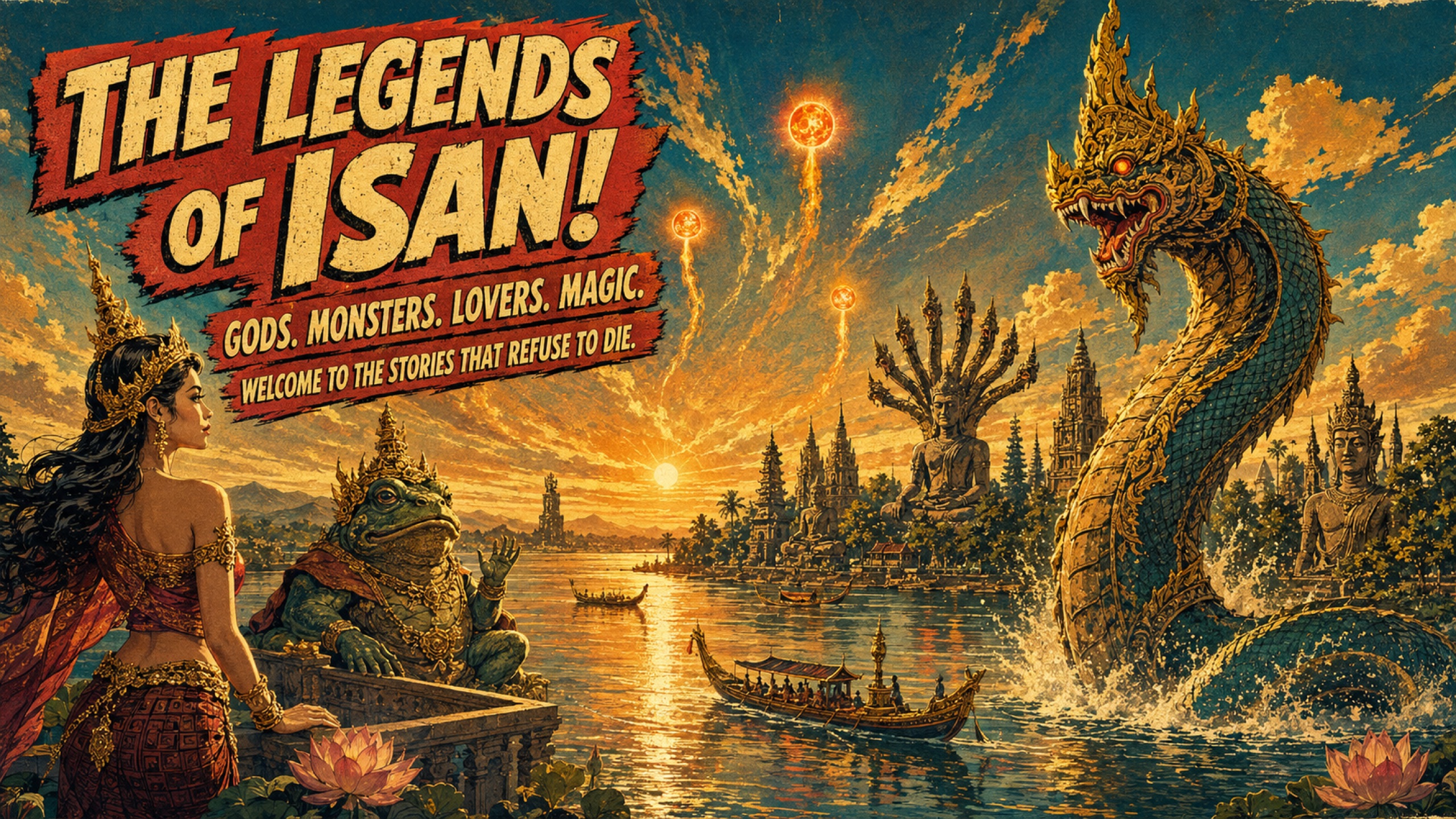
Every winter, something extraordinary happens on the plains south of Udon Thani. As dawn breaks over Nong Han Kumphawapi, millions of pink flowers rise above the water. In places they stretch so far towards the horizon that the lake seems to disappear beneath them. Boats move quietly between the blooms while the first sunlight catches the mist. Today we call it the Red Lotus Lake, or Talay Bua Daeng. But long before anyone came here to photograph the flowers, people in Isan were telling a much darker story about how this enormous lake came to exist. It is the story of Nang Ai.
A story about love, jealousy, reincarnation, an enchanted white squirrel, a disastrous rocket festival and a war between humans, Nagas and ghosts. And, like many of Isan's greatest legends, it begins long before the main characters are born.
A Story Told for Generations
The story usually known as Phadaeng Nang Ai is one of the great folk epics of northeastern Thailand and Laos. Versions were preserved in palm-leaf manuscripts and performed and retold orally, which means there has never been one immutable version. Names, places and episodes change from storyteller to storyteller.
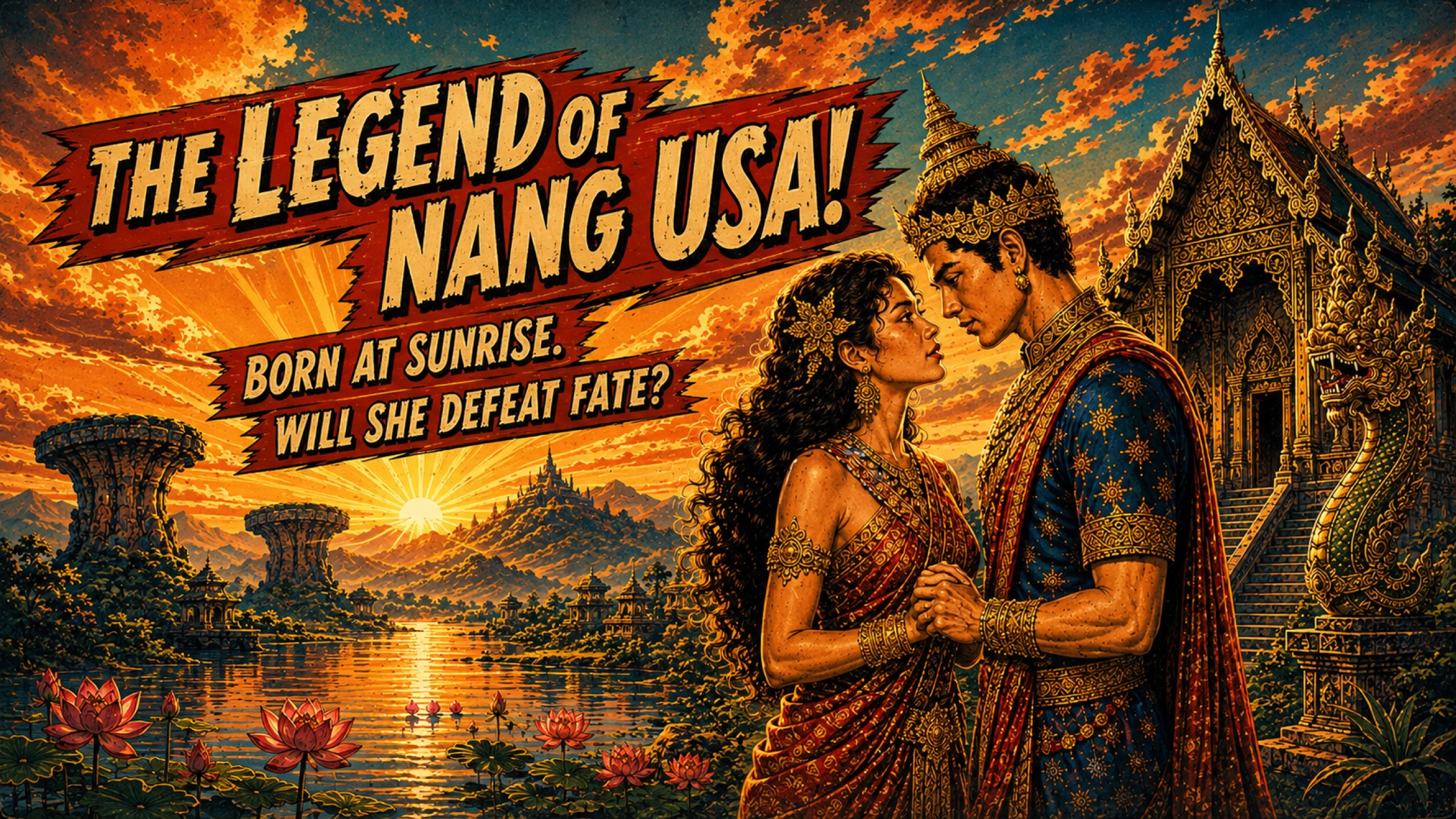
The telling most closely connected with Kumphawapi in Udon Thani places Nang Ai's kingdom where the Red Lotus Lake lies today. At the heart of almost every version are three people: Nang Ai, a princess; Phadaeng, the man she loves; and Phangki, a Naga prince who loves her too. Unfortunately for all three of them, theirs is not the first lifetime in which they have met.
A Promise Made in Another Life
Before Nang Ai was a princess and before Phangki was a Naga prince, the two are said to have been husband and wife. It was not a happy marriage. In one important telling, Phangki had been born a poor mute man. Nang Ai, in that lifetime, became his devoted wife, but her affection was returned with indifference. Eventually he decided to return to his own family and she travelled with him through the forest.
The journey was difficult — Nang Ai carried their provisions while her husband offered little help. Eventually they stopped beneath a fig tree. He climbed into it to gather fruit. Then he abandoned her.
Left alone in the forest, frightened and devastated by the betrayal, Nang Ai finally reached a river. There she made a terrible vow: she prayed that in another life this man would suffer for what he had done to her, and that they would never again become husband and wife. Then their lives ended. But in the world of the legend, promises made in one life do not disappear when another begins. They wait.

The Princess of the Lost Kingdom
Nang Ai was reborn as the daughter of the ruler of a prosperous kingdom usually called Ekachathita or, in Kumphawapi tradition, associated with Suwannakhomkham. She grew into a young woman whose beauty became famous far beyond her father's lands. Among those who heard about her was Phadaeng, ruler or prince of Phaphong. He travelled to see her, and unlike the relationship ordained by an unhappy previous life, this time something entirely different happened: Nang Ai and Phadaeng fell in love.
Phadaeng returned home intending to prepare for their marriage. But beneath the human world lived another kingdom, ruled by the great Naga King Suttho. And his son was Phangki — the same soul that had once been Nang Ai's husband had found her again.
Rockets to the Heavens
Then came the great Bun Bang Fai, the Rocket Festival. The tradition survives across Isan today: great homemade rockets are launched towards the heavens as part of ceremonies associated with calling for the seasonal rains.
In the legend, Nang Ai's father organised a magnificent competition and summoned rulers and princes from across the region, adding an irresistible prize: the man whose rocket won could marry Nang Ai. Phadaeng came determined to win the woman he already loved. His rocket failed spectacularly. Neither did Nang Ai's father's rocket win — in the Kumphawapi version the contest effectively ended in a draw, leaving the promised marriage unresolved.
Watching all this was another visitor. Phangki had left the Naga kingdom and come to the human world. He saw Nang Ai, and immediately fell hopelessly in love with her.

The White Squirrel With the Golden Bell
Phangki returned beneath the earth, but he could not forget Nang Ai. His father warned him against returning — humans and Nagas belonged to different worlds and nothing good could come from pursuing her. Phangki ignored him. He returned to Nang Ai's city and used his supernatural powers to transform himself into an extraordinarily beautiful white squirrel, a golden bell hanging around his neck.
He climbed through the trees surrounding Nang Ai's palace, deliberately allowing the bell to ring as he jumped from branch to branch. Nang Ai heard it, saw the remarkable animal, and wanted to keep it as a pet. She ordered the palace hunters to catch it. The squirrel was impossibly quick, but eventually one of the hunters raised his weapon. Whether Nang Ai ordered the animal killed or merely captured varies with the storyteller — but the arrow struck home. The white squirrel fell, and as Phangki lay dying inside its body, the promise from another lifetime was fulfilled.
Yet Phangki made one final wish of his own: he prayed that his flesh would become impossibly delicious, and that there would be enough of it to feed the entire kingdom.

The Feast
When the hunters began butchering the squirrel, something impossible happened. There was more meat than the small animal could possibly contain. They cut away one portion. Another appeared. Soon enormous quantities of meat were being carried throughout the city, and everyone ate — nobles, soldiers, farmers, villagers, and Nang Ai herself.
Only a few people received none. In one enduring local version, the widows of the kingdom were excluded from the feast because they had no husbands serving the king and were therefore considered undeserving of a share. It seemed an insignificant act of cruelty. It would save their lives. Because far beneath the earth, word had reached King Suttho: his son had been killed, and the humans had eaten him.
The Nagas Rise
The Naga King was consumed by grief and rage. He summoned an army of Nagas and gave them a simple command: destroy the kingdom, and kill everyone who had eaten the flesh of Phangki. That night, the earth began to move, storms gathered over the city, and thousands upon thousands of Nagas surged upwards from the subterranean world. The ground collapsed behind them. Homes disappeared. Muddy water poured across the countryside as the prosperous kingdom began sinking into the earth.
Those who had not eaten Phangki's flesh were spared, and so the land beneath the widows remained above the flood. According to local tradition, these surviving pieces of land became islands within the lake, including the place remembered as Don Mae Mai, the Island of the Widows, associated today with Ban Don Kaew. But Nang Ai had eaten the squirrel. The Nagas were coming for her.

The Ride of Phadaeng and Nang Ai
When Phadaeng learned what was happening, he rode desperately back towards Nang Ai's collapsing kingdom on his great horse, Bak Sam. He found her, pulled her onto the horse, and fled. Behind them came the Nagas. In some of the most wonderfully specific Kumphawapi versions of the story, the couple carried possessions with them as they escaped, and the weight slowed Bak Sam — a drum fell and became one local waterway, a great gong was abandoned and another stream took its name.
Still the Nagas came. Then one reached them. A gigantic Naga tail lashed through the air. It caught Nang Ai. She was swept from the horse and dragged beneath the water into the Naga realm. Phadaeng could do nothing. The woman he had crossed kingdoms to find disappeared before his eyes.

The Birth of Nong Han
By morning the kingdom was gone. Where palaces, houses, farms and roads had once stood there was now an immense body of water. According to the legend, this became Nong Han Kumphawapi — the lake we see today. Only scattered islands remained where those who had not eaten Phangki's flesh had survived.
The Army of the Dead
Phadaeng returned to his kingdom broken by grief, and eventually he died. But death was not enough to end his love or his anger. Phadaeng became a powerful ghost lord, gathered an enormous army of spirits, and marched against the kingdom of the Nagas beneath the waters. The dead fought the Nagas, and the battle raged until neither side could defeat the other.
Finally a divine authority intervened, identified in different tellings as Indra or Vessavana. Enough. Neither side would be permitted to possess Nang Ai. The Nagas returned beneath the waters. Phadaeng and his ghost army withdrew. And Nang Ai was to remain in the underwater realm until the coming of Phra Si Ariya Maitreya, the future Buddha, when the dispute could finally be judged. There the great epic ends — not with a victor, but with everyone forced, at last, to stop fighting.
The Flowers Return
And perhaps that is why the final chapter of Nang Ai's story is not found in the old kingdoms at all. It is found on the lake. For a few months each year, as the cool season settles across Isan, Nong Han changes. Before sunrise the water is dark and seemingly empty. Then the light comes. Across kilometre after kilometre of water, millions of pink flowers open.
Modern botany tells us that they are tropical water lilies rather than true lotuses. Legend offers a different explanation: the flowers are the lake's remembrance of Nang Ai, beauty returning each year from a kingdom that disappeared beneath the water. And so one of the most violent stories ever told in Isan ends somewhere extraordinarily peaceful — a drowned kingdom, a Naga world somewhere beneath the boat, and above it, as the sun rises, an impossible sea of pink.

That is the legend of Nang Ai. And once you know it, an early morning on the Red Lotus Lake never feels quite the same again.