

Most people arrive in Isan expecting rice fields, temples, spicy food and the Mekong.
They probably do not expect dinosaurs.
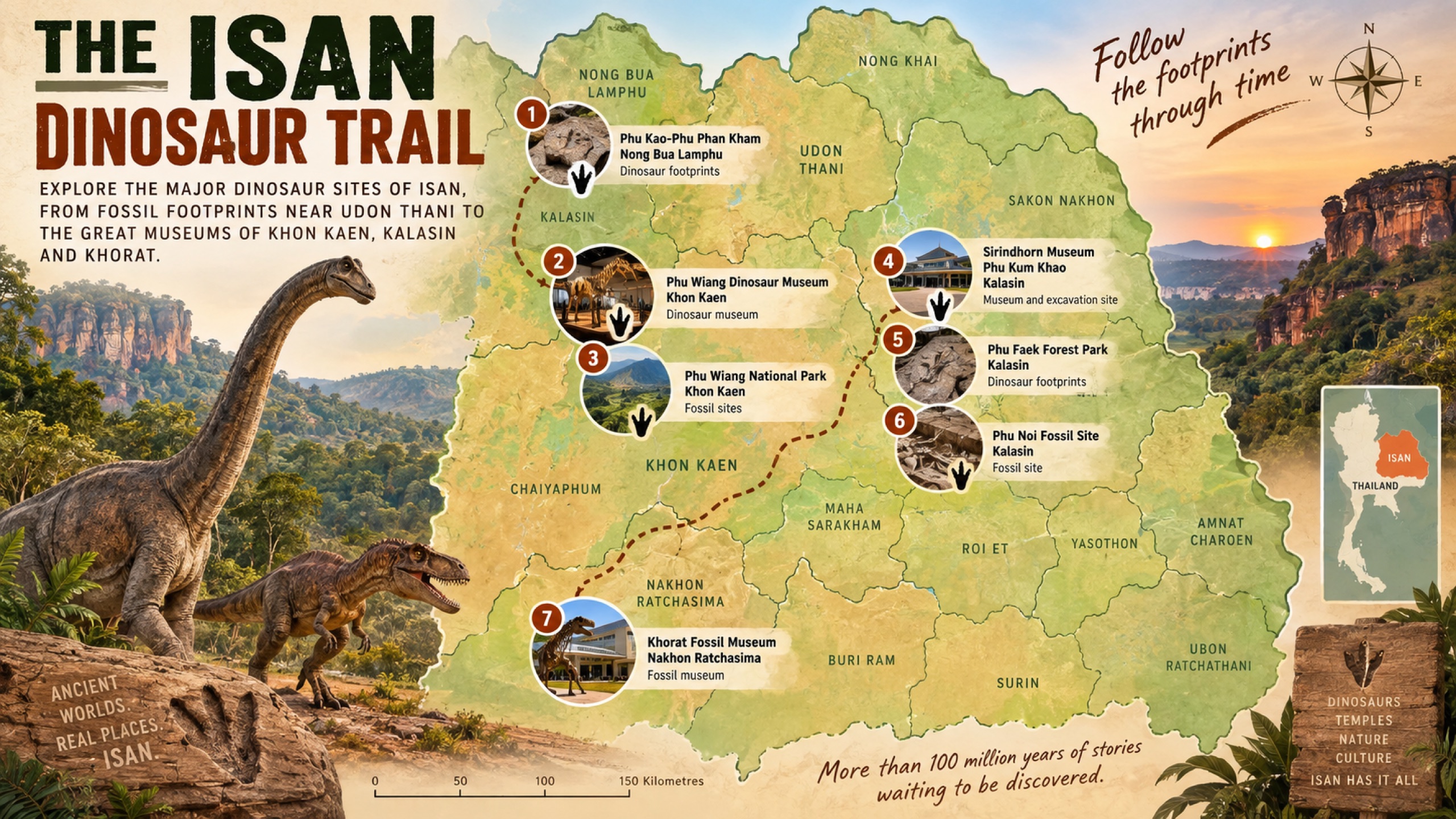
Yet beneath the red earth of Northeast Thailand lies one of the most remarkable dinosaur stories in Southeast Asia. Fossil bones, teeth and footprints have been discovered across Isan, from Nong Bua Lamphu and Khon Kaen to Kalasin, Chaiyaphum and Nakhon Ratchasima.
Some belonged to enormous long-necked plant eaters. Others came from two-legged predators. Several were species previously unknown to science and were eventually given names celebrating the places and people of Thailand.
And it all began largely by accident.
The discovery that changed everything

In 1976, Thai geologist Sutham Yaemniyom was surveying for uranium in the mountains around Phu Wiang in Khon Kaen Province when he found a large piece of fossilised bone.
It turned out to be part of the thigh bone of a sauropod, one of the giant long-necked dinosaurs.
It was the first scientifically reported dinosaur discovery in Thailand. Further expeditions followed, including major Thai-French palaeontological projects, and Phu Wiang gradually revealed an extraordinary collection of dinosaur remains. Today there are nine recognised excavation sites around the Phu Wiang area.
Thailand had entered the dinosaur age.
Or, more accurately, rediscovered it.
Why Isan?

The answer is underneath your feet.
Much of Northeast Thailand sits on the Khorat Plateau, where huge layers of sandstone, mudstone and other sedimentary rocks were laid down during the Mesozoic Era, the great age of the dinosaurs.
These rocks, known collectively as the Khorat Group, include continental "red beds" stretching back from the Late Triassic through much of the Jurassic and Cretaceous periods. In the right conditions, rivers, floodplains and shallow bodies of water buried animal remains and footprints beneath sediment. Over millions of years, some of those remains fossilised.
Today erosion occasionally opens those ancient layers again.
A hillside, stream bed or road cutting can suddenly expose something which has not seen daylight for more than 100 million years.
That is why the dinosaur story of Isan is still not really finished.
New discoveries continue to be made.
Meet some of the dinosaurs of Isan

Perhaps the most famous is Phuwiangosaurus sirindhornae, a large four-legged sauropod discovered at Phu Wiang and later at other sites in Isan.
With its long neck, long tail and enormous body, Phuwiangosaurus was one of the giants of Early Cretaceous Thailand. Fossils from several individuals have been discovered, including remarkably complete remains at Phu Kum Khao in Kalasin.
Then there were the predators.
Siamotyrannus isanensis was discovered at Phu Wiang and named partly after Isan itself. It was a substantial two-legged meat-eating theropod, although scientists' understanding of exactly where it belongs in the theropod family tree has evolved since its discovery.
Another Isan predator, Siamosaurus suteethorni, is known particularly from distinctive cone-shaped teeth resembling those of a crocodile. It has been associated with the spinosaur group of dinosaurs, predators whose members are often linked with fish-eating adaptations.
And then there is Isanosaurus attavipachi, discovered in Chaiyaphum.
It lived far earlier, around the end of the Triassic Period, and is regarded as one of the earliest known sauropods. Long before the gigantic sauropods of the Jurassic reached their most spectacular forms, one of their early relatives was already walking across what would eventually become Isan.
Further south, Nakhon Ratchasima has produced important plant-eating dinosaurs including Sirindhorna khoratensis, an Early Cretaceous ornithopod whose skull remains make it one of Southeast Asia's best-preserved dinosaurs of its type.
These were not simply "Thai versions" of famous American dinosaurs.
They belonged to ecosystems that existed here.
This was their world.
Phu Wiang, where Thailand's dinosaur story began

If you visit just one dinosaur region in Khon Kaen, make it Phu Wiang.
The Fossil Research Center and Dinosaur Museum explains the geology and discoveries before you head further into the mountains. Displays include fossils, reconstructions and information about the dinosaurs found in the surrounding area.
Then there is Phu Wiang National Park itself.
This is what makes the area special. You are not simply looking at dinosaur models inside a building. Fossil excavation sites lie among the forested mountains where the original bones were discovered.
The landscape is part of the story.
More than 100 million years ago, animals were walking across this ground.
Today you can walk through it too.
Kalasin, Thailand's dinosaur country

If Phu Wiang started the story, Kalasin turned it into something enormous.
The centrepiece is the Sirindhorn Museum at Phu Kum Khao, one of Thailand's most important dinosaur museums and palaeontological research centres.
Its origins are particularly Isan.
A fossil bone was discovered near Wat Sakkawan, and subsequent excavation revealed a major concentration of dinosaur material. Researchers found numerous bones from several sauropods, including remarkably complete remains.
The excavation area has been preserved alongside the museum, so visitors can see both the scientific displays and the place where fossils actually came from. The Tourism Authority of Thailand describes Kalasin as containing Thailand's largest concentration of dinosaur fossils.
For families, it is probably the strongest single dinosaur destination in Isan.
Walk in a dinosaur's footprints at Phu Faek

Bones are impressive.
Footprints are somehow different.
At Phu Faek Forest Park in Kalasin, dinosaur tracks remain impressed in exposed sandstone.
They are not casts placed there for tourists.
A living animal physically stepped onto that surface more than 100 million years ago.
The Department of Mineral Resources records Phu Faek as one of Isan's important dinosaur footprint sites.
There is something wonderfully simple about standing beside a dinosaur footprint. You do not need to understand palaeontology.
It walked here.
You are standing here.
There are roughly a hundred million years between the two events.
Dinosaurs surprisingly close to Udon Thani

For visitors staying around Udon Thani, one of the most interesting sites is across the provincial border in Nong Bua Lamphu.
Dinosaur footprints have been found inside Phu Kao-Phu Phan Kham National Park.
The prints occur in sandstone belonging to the Early Cretaceous Sao Khua Formation. Scientific study has identified several trackways and individual prints left by dinosaurs walking through this landscape.
The park also contains prehistoric human rock art, viewpoints, forests and the landscape around Ubolratana Reservoir.
That creates a rather extraordinary timeline.
Dinosaurs walked here more than 100 million years ago.
Humans left their marks thousands of years ago.
And you can explore evidence of both in the same landscape.
Phu Noi, where discoveries are still being made

Kalasin has another site which receives far less tourist attention but is scientifically extraordinary.
Phu Noi, in Kham Muang District, has produced a remarkable collection of fossils dating to roughly 150 million years ago.
The Department of Mineral Resources has described it as one of Thailand's richest and most diverse fossil sites. Excavations have uncovered dinosaurs as well as ancient fish, freshwater sharks, crocodilians, turtles, shellfish and plants. Hundreds, and eventually more than a thousand, fossil specimens were recovered from the site.
It gives us something more valuable than simply another dinosaur skeleton.
It provides a glimpse of an entire lost ecosystem.
And the story continues south to Khorat

Nakhon Ratchasima, usually simply called Khorat, adds another chapter.
The Khorat Fossil Museum explores dinosaurs alongside fossilised forests and prehistoric mammals, forming part of the wider Khorat UNESCO Global Geopark landscape.
The museum is particularly useful because it places dinosaurs within a much bigger story.
The history beneath Isan did not begin when dinosaurs appeared, and it did not end when they disappeared. The rocks record changing landscapes, forests, animals, climate and millions upon millions of years of change.
Isan before Isan

We tend to think of Isan through human history.
The Khmer temples. The ancient settlements. The Mekong. The Lan Xang kingdoms. The villages, rice fields and cities that developed across Northeast Thailand.
But those stories occupy only the tiniest fraction of the region's history.
Long before there was an Udon Thani, a Khon Kaen or a Kalasin, rivers crossed this landscape. Forests grew here. Giant herbivores moved through them. Predators followed.
Somewhere an animal put its foot into wet sand.
Another died beside a river.
Sediment covered them.
Continents moved. Mountains rose. Species vanished.
And more than a hundred million years later, someone walking through an Isan stream bed noticed something unusual sticking out of the rock.
That may be the most surprising thing about the dinosaurs of Isan.
They are not really gone.
Their world is still here, buried just beneath ours.