
Where History, Buddhism and Naga Legend Meet
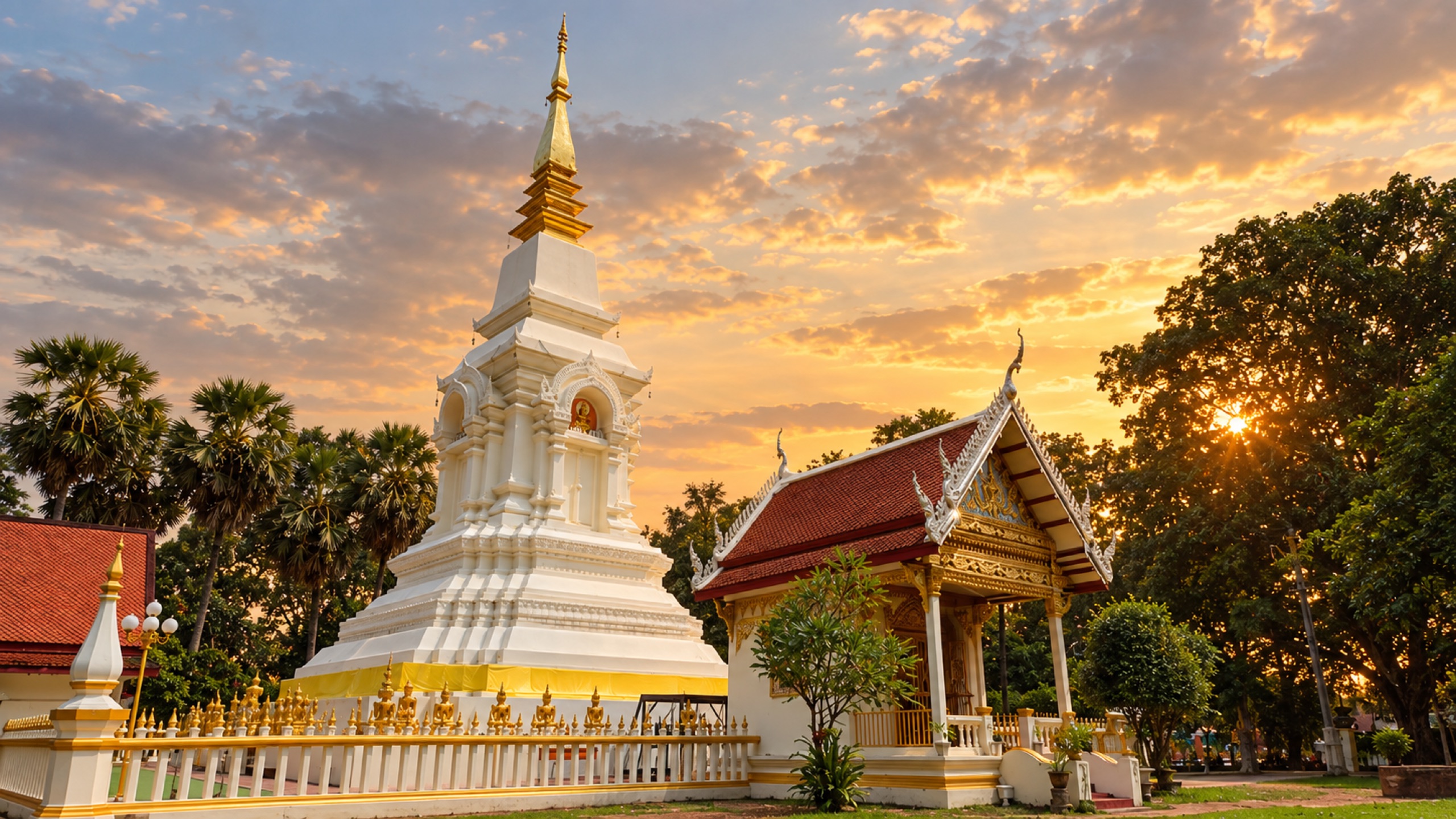
At Wat Phra That Bang Phuan, Buddhist relics, ancient Lan Xang history and the legends of the Naga come together in one extraordinary temple landscape.
Check Nakara Availability NowDrive through the countryside southwest of Nong Khai and you can easily pass Wat Phra That Bang Phuan without realising quite how extraordinary it is.
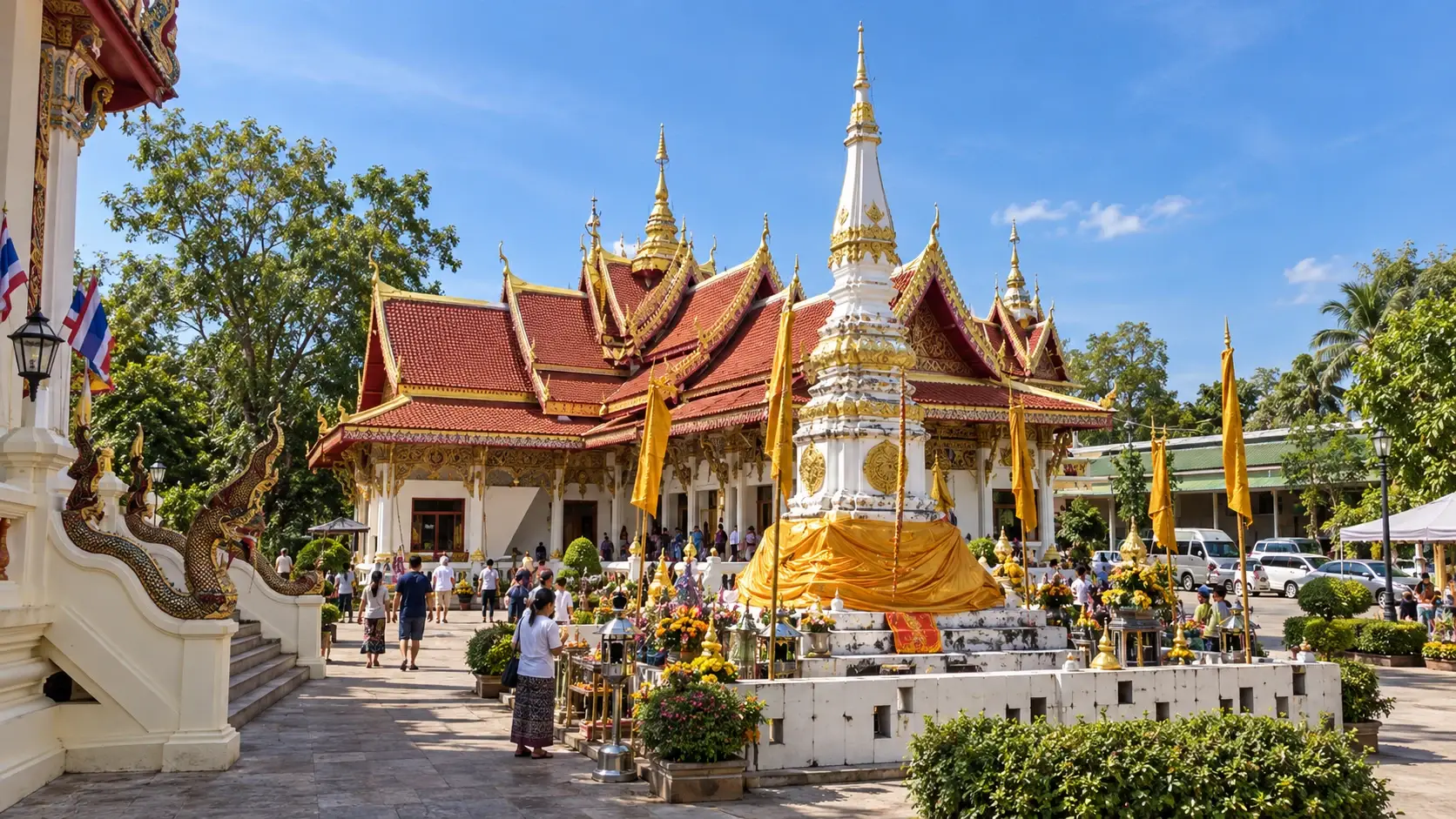
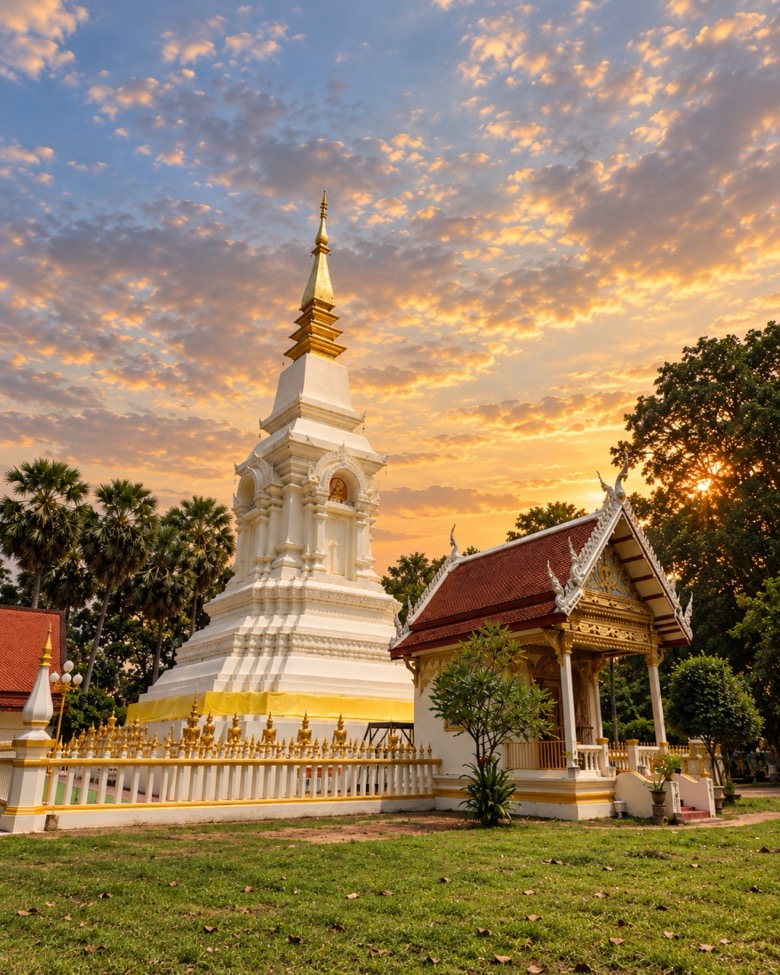
At first sight, its great white-and-gold stupa is the obvious attraction. But Phra That Bang Phuan is much more than one beautiful Buddhist monument.
This is an archaeological site with connections to the kings of the old Lan Xang kingdom, a sacred place associated by tradition with relics of the Buddha, home to an exceptionally rare group of seven monuments representing the weeks following the Buddha's enlightenment, and the location of a sacred pond deeply connected with the legends of the Naga.
It is also a useful reminder that the modern border between Thailand and Laos tells us very little about the world in which this temple developed. For centuries, communities, rulers and religious traditions moved across both sides of the Mekong. Phra That Bang Phuan belongs to that wider cultural landscape.
For travellers interested in Thai history, Buddhism, archaeology or the Naga traditions of the Mekong, it deserves considerably more attention than it normally receives.
Why Is Wat Phra That Bang Phuan Important?
Phra That Bang Phuan has long been regarded as one of the important sacred monuments of Nong Khai.
Its significance comes from several layers of history and belief.
The central Phra That, or relic stupa, is associated with traditions that relics of the Buddha were enshrined here. The site was also patronised by rulers of the Lan Xang kingdom, most importantly King Setthathirat, one of the most important rulers in the history of Laos and the middle Mekong region.
Around the main stupa are older religious structures forming the Sattamahasathan, seven sacred places representing the seven locations associated with the Buddha during the seven weeks following his enlightenment.
The temple also contains Mucalinda Pond, commonly known as the Naga Pond, where Buddhist symbolism has merged with much older Mekong beliefs surrounding Nagas, sacred water and the spiritual landscape.
The result is unusual. Phra That Bang Phuan is not simply a temple containing an impressive chedi. It is an entire sacred landscape.
A Temple from the World of Lan Xang
Understanding Phra That Bang Phuan means temporarily forgetting today's national boundaries.
Before Nong Khai became a Thai border province facing Laos across the Mekong, this region formed part of a cultural world closely associated with Lan Xang, the kingdom that dominated much of present-day Laos and parts of northeastern Thailand.
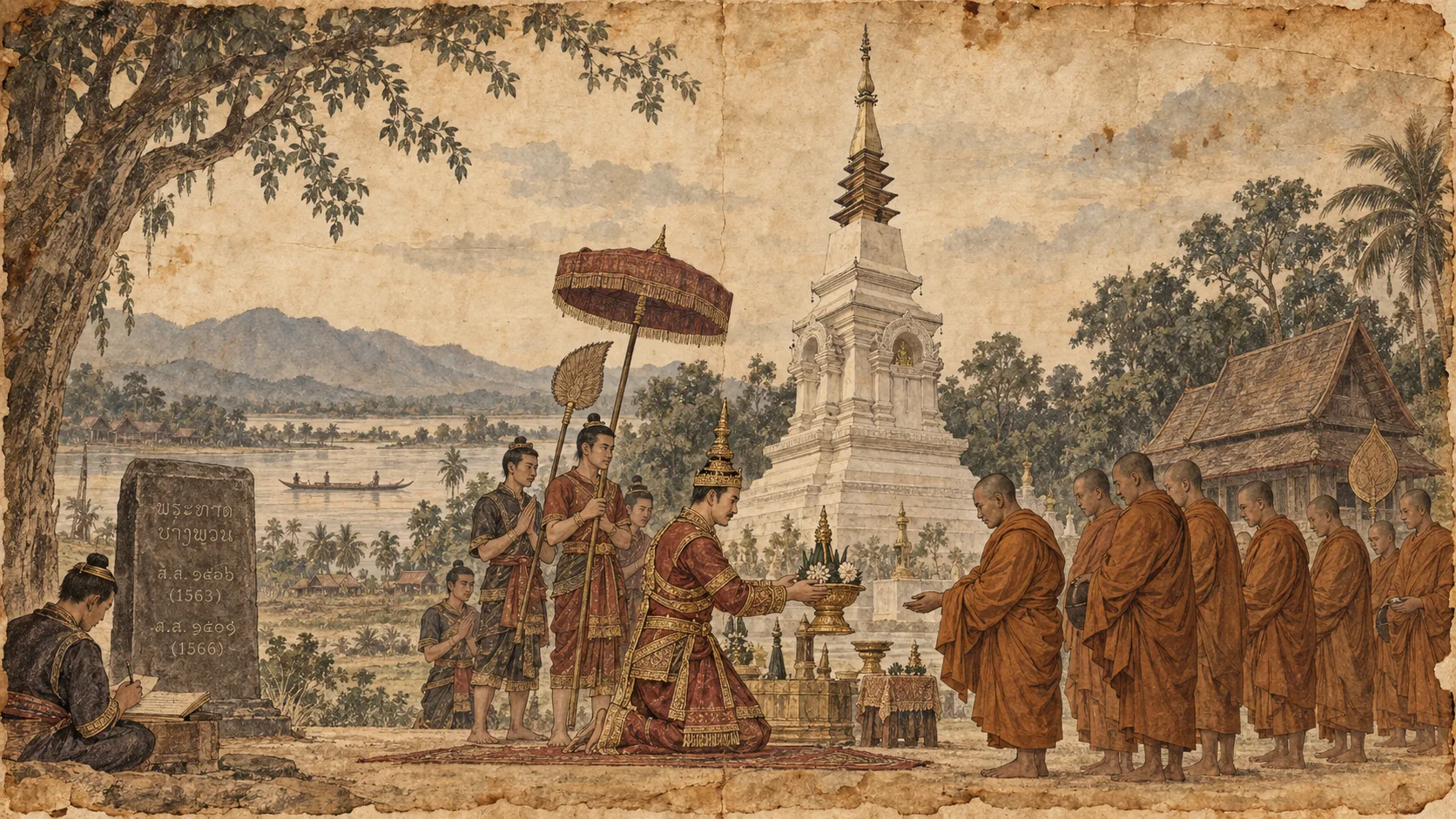
One of the most important figures in that history was King Setthathirat, who moved the Lan Xang capital from Luang Prabang to Vientiane in the 16th century.
Historical evidence connects him directly with Phra That Bang Phuan.
An inscription dated to 1563 refers to merit-making by Setthathirat at Phra That Bang Phuan. Another inscription from 1566 records royal activity connected with the site and donations made for worship of the great relic monument.
This is much stronger evidence than simply relying upon later legends.
It tells us that by the middle of the 16th century, Phra That Bang Phuan was important enough to receive royal attention from one of Lan Xang's greatest kings.
So Who Actually Built Phra That Bang Phuan?
There is no completely straightforward answer.
That is actually one of the most interesting aspects of the site.
Later traditions associate the original sacred monument with much earlier rulers, including King Chanthaburi of Vientiane. Other accounts have attributed construction or earlier patronage to King Photisarath, father of Setthathirat.
Archaeology suggests that the monument itself developed in stages.
When the old stupa collapsed in 1970, investigation revealed evidence of at least three phases of construction. An earlier laterite base had subsequently been enclosed in brick, and the monument was later enlarged again into the architectural form associated with the Setthathirat period.
That makes it misleading to attribute everything visible at Bang Phuan to one king or one moment in history.
A better way to understand it is as a sacred site that grew over centuries, repeatedly rebuilt, enlarged and reinterpreted as different generations continued to regard it as important.
King Setthathirat and the Golden Age of the Temple
Setthathirat's involvement is especially significant because it places Phra That Bang Phuan within a much bigger political and religious project.
After the Lan Xang capital shifted towards Vientiane, the middle Mekong became increasingly important. Royal patronage strengthened temples and sacred monuments throughout the region.
Phra That Bang Phuan appears to have been part of this landscape of royal Buddhist patronage.
The site's architecture also shows connections with both Lan Xang and Lanna artistic traditions. Academic analysis has suggested that the Sattamahasathan may reflect influences Setthathirat encountered during his earlier association with the Lanna kingdom centred on Chiang Mai.
That makes Bang Phuan particularly fascinating. It stands in modern Thailand, is deeply associated with Lan Xang history, and preserves architectural ideas influenced by a much wider Buddhist world.
The Day the Ancient Stupa Fell
The gleaming stupa visitors see today should not be mistaken for an untouched 16th-century structure.
On 20 June 1970, the historic Phra That Bang Phuan collapsed.
The disaster exposed earlier construction underneath the monument and provided archaeologists with an opportunity to investigate its different building phases. The site had already been officially registered as an archaeological monument in 1952.
The Fine Arts Department subsequently reconstructed the stupa.
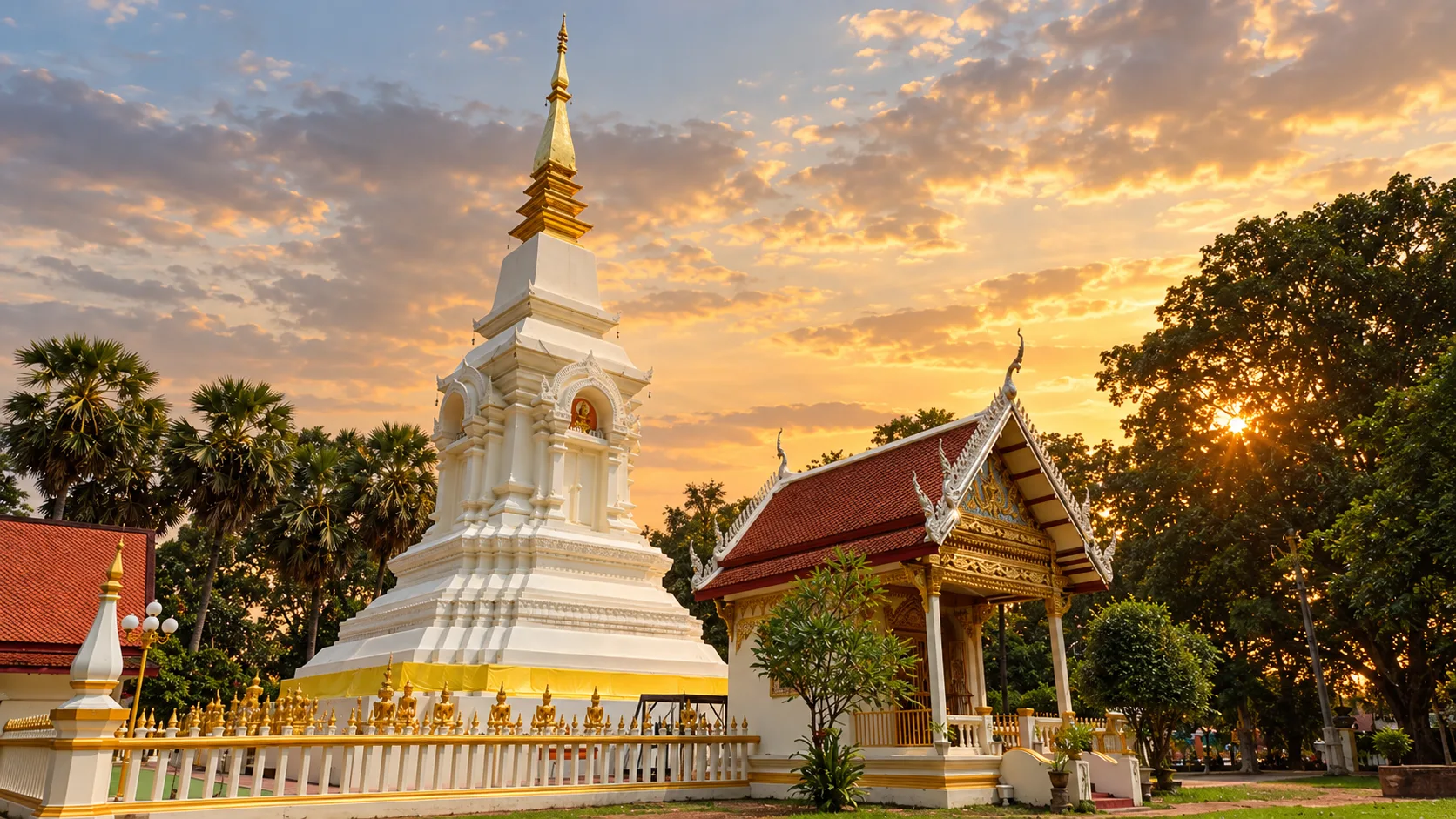
The restored monument rises approximately 34 metres, from a square base roughly 17 metres across, following the general architectural character of the earlier structure while incorporating modern reconstruction.
The restoration was completed during the late 1970s. On 27 November 1978, King Bhumibol Adulyadej, Queen Sirikit and members of the royal family attended the ceremony associated with placing the finial on the restored monument.
So when you visit, you are looking at something slightly more complicated than an "ancient stupa."
The sacred site is ancient. Parts of the archaeological landscape are ancient. The monument has centuries of history behind it.
But the main white stupa standing today is a carefully reconstructed successor to the structure that collapsed in 1970.
The Sattamahasathan: Seven Sacred Places
For many historically minded visitors, the most remarkable part of Wat Phra That Bang Phuan is not actually the large reconstructed stupa.
It is the Sattamahasathan, literally the Seven Great Places.
These structures recreate the sacred locations associated in Buddhist tradition with the seven weeks following Siddhartha Gautama's enlightenment beneath the Bodhi tree.
The surviving ensemble at Bang Phuan is exceptionally rare and gives visitors an opportunity to walk through Buddhist sacred geography rather than simply viewing a single religious monument. Thai tourism and Buddhist authorities give the seven places as:
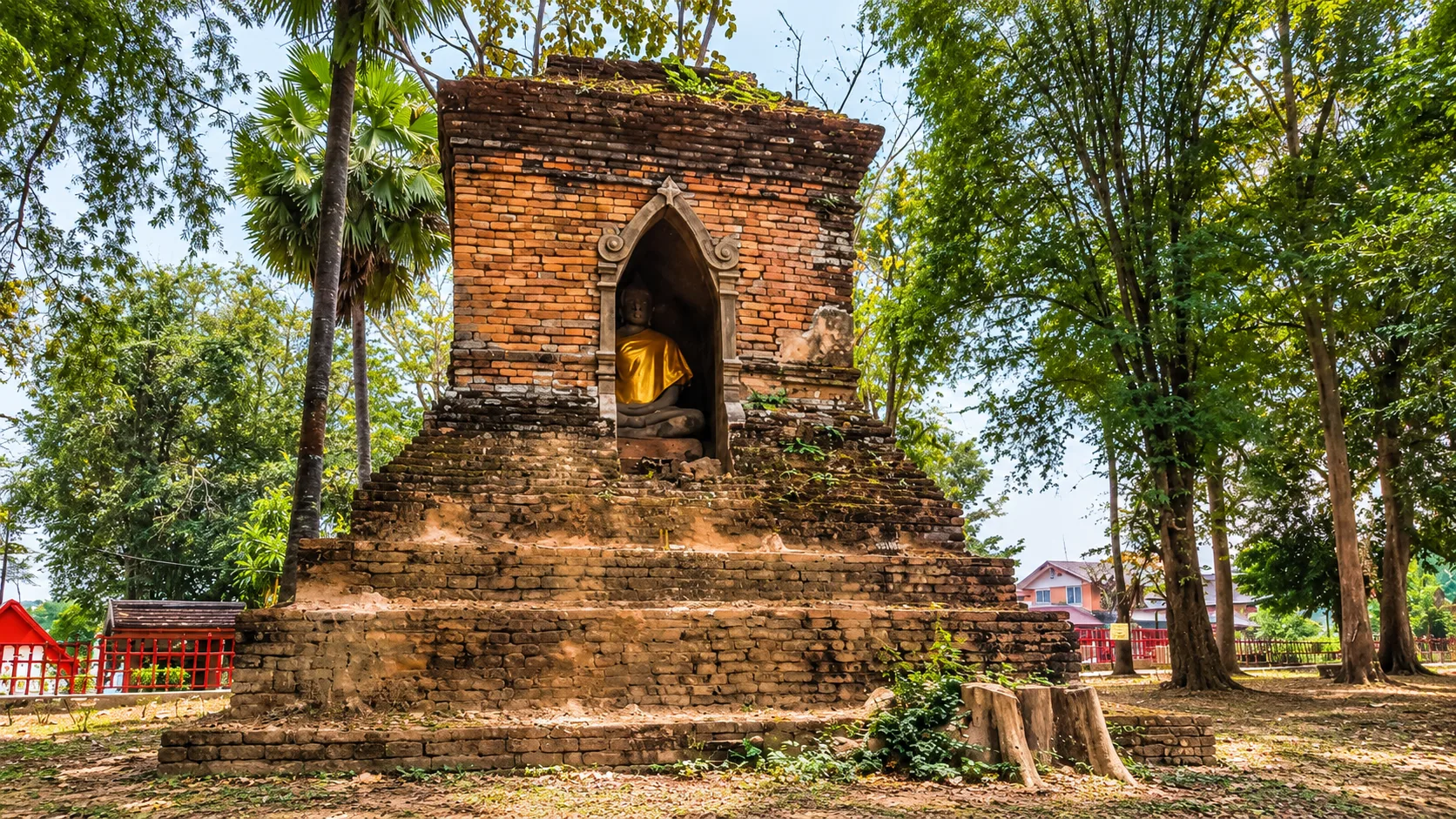
Bodhi Pallanka, representing the place beneath the Bodhi tree where the Buddha attained enlightenment. Animisa Chedi, associated with the Buddha contemplating the Bodhi tree in gratitude. Rattana Cankama, representing the jewelled walking path where he practised walking meditation. Rattanaghara, the jewelled chamber associated with meditation and contemplation. Ajapala Nigrodha, representing the banyan tree beneath which the Buddha stayed following enlightenment. Mucalinda, associated with the Naga king who protected the Buddha during a storm. Rajayatana, representing the tree beneath which the Buddha spent the seventh week after enlightenment.
Rather than rushing straight to the large stupa and leaving, take time to find these smaller monuments.
They are one of the principal reasons Phra That Bang Phuan is historically unusual.
History Tells One Story. Legend Tells Another.
This is where Phra That Bang Phuan becomes even more interesting.
The inscriptions and archaeological remains give us evidence for the site's Lan Xang history.
But the sacred traditions surrounding the temple push its story much further back in time.
The Urangkhathat tradition, an important body of legends concerning sacred relics in the Mekong region, describes monks bringing relics of the Buddha from India and distributing them among sacred places along the Mekong.
According to this tradition, 29 relics of the Buddha were enshrined at the place that became Phra That Bang Phuan. King Chanthaburi of Vientiane is associated in the legend with the construction of a monument to house them.
This is sacred tradition rather than independently verified history.
That distinction matters.
There is strong historical evidence that Phra That Bang Phuan was an important religious site during the Lan Xang period. There is not equivalent archaeological evidence proving the much earlier events described in the relic legend.
But dismissing the legend would also miss an important part of the temple.
For centuries, these stories have shaped how people understand, worship at and protect Phra That Bang Phuan.
They are part of its history, even where they cannot be treated as literal archaeological fact.
The Naga Pond and the Legend of Mucalinda
If you have been exploring the temples and legends of Nong Khai, one feature of Phra That Bang Phuan will immediately feel familiar.
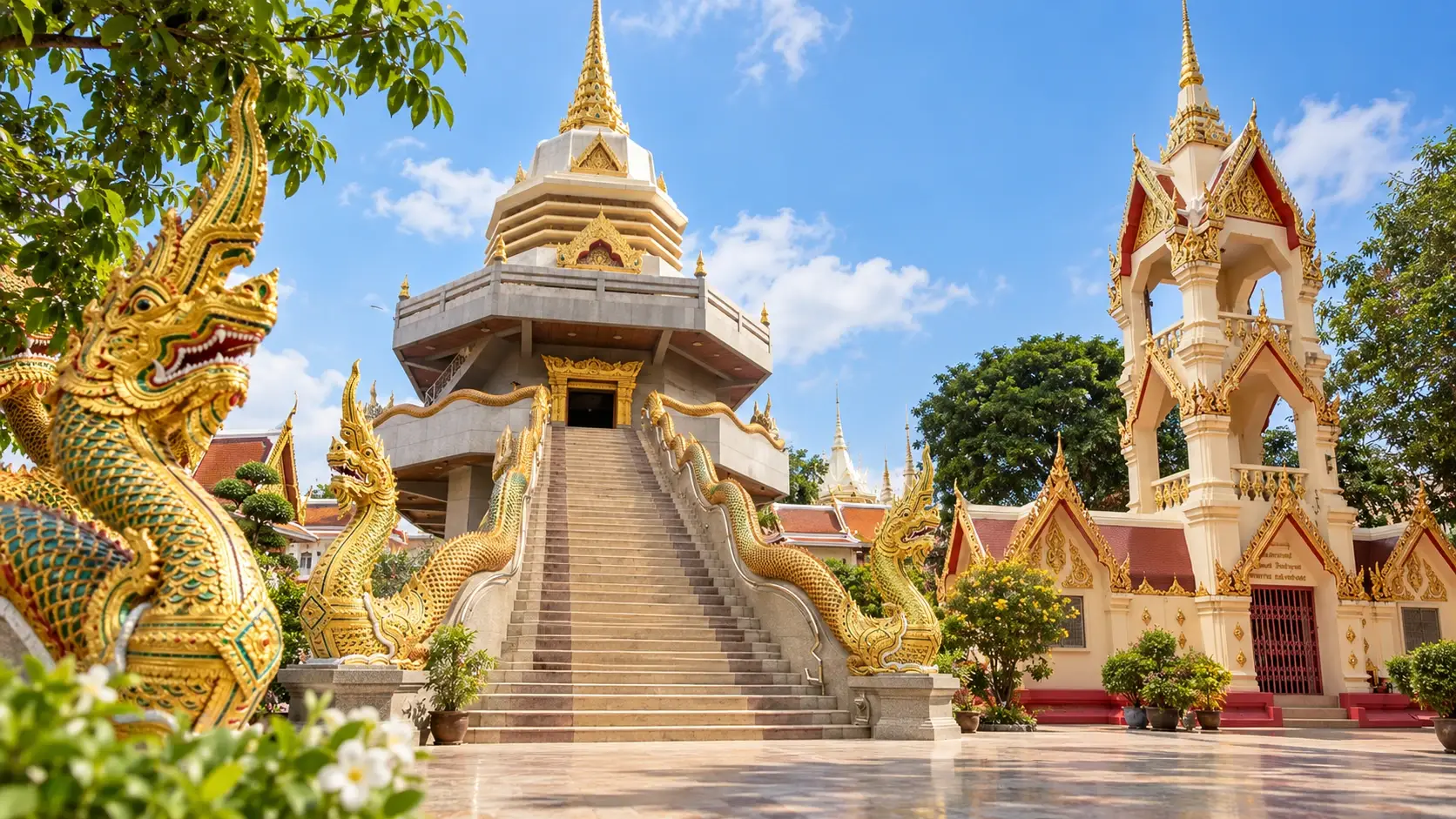
The Naga is here too.
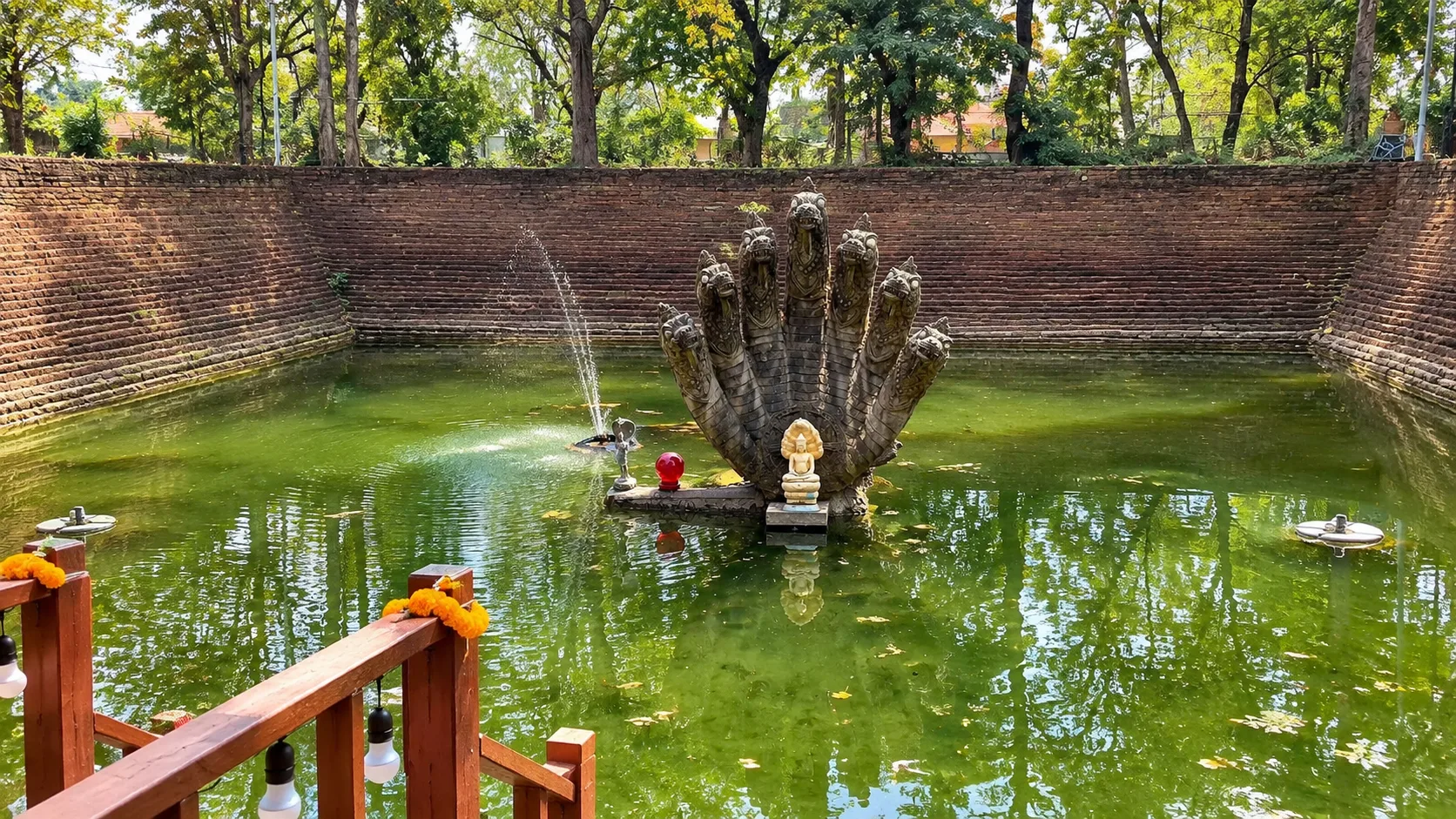
Mucalinda Pond, or Sa Mucalinda, is an ancient sacred pool within the temple grounds and is closely connected with both Buddhist teachings and the Naga traditions of the Mekong.
In Buddhist tradition, Mucalinda is the Naga king who emerged while the Buddha was meditating after enlightenment. When a great storm came, Mucalinda coiled his body around the Buddha and spread his hood above him, protecting him from the rain.
At Bang Phuan, Mucalinda forms part of the Sattamahasathan landscape.
But local traditions take the story further.
Accounts preserved by Thai Buddhist authorities describe a legend in which water began emerging mysteriously from the earth after the Buddha relics were installed. The spring was associated with the Naga believed to guard the sacred site, and a pond was created to contain the water.
A seven-headed Naga came to symbolise the pond.
Sacred Water and the Kings of the Mekong
The water of Mucalinda Pond has itself acquired considerable ceremonial importance.
Thai tourism sources record traditions of water from the pond being used historically in important ceremonies, including ceremonies of allegiance and later royal rites.
Again, Bang Phuan brings together several worlds.
There is Buddhist symbolism, Lan Xang royal history and older regional beliefs in Nagas and sacred water.
This fusion is one reason Naga traditions remain so powerful throughout Nong Khai and the wider Mekong region. The Naga is not simply a mythical monster decorating temple staircases. It can represent protection, water, fertility, sacred geography and the boundary between the human and supernatural worlds.
Phra That Bang Phuan is an excellent place to begin understanding that deeper story.
What Should You Look For When Visiting?
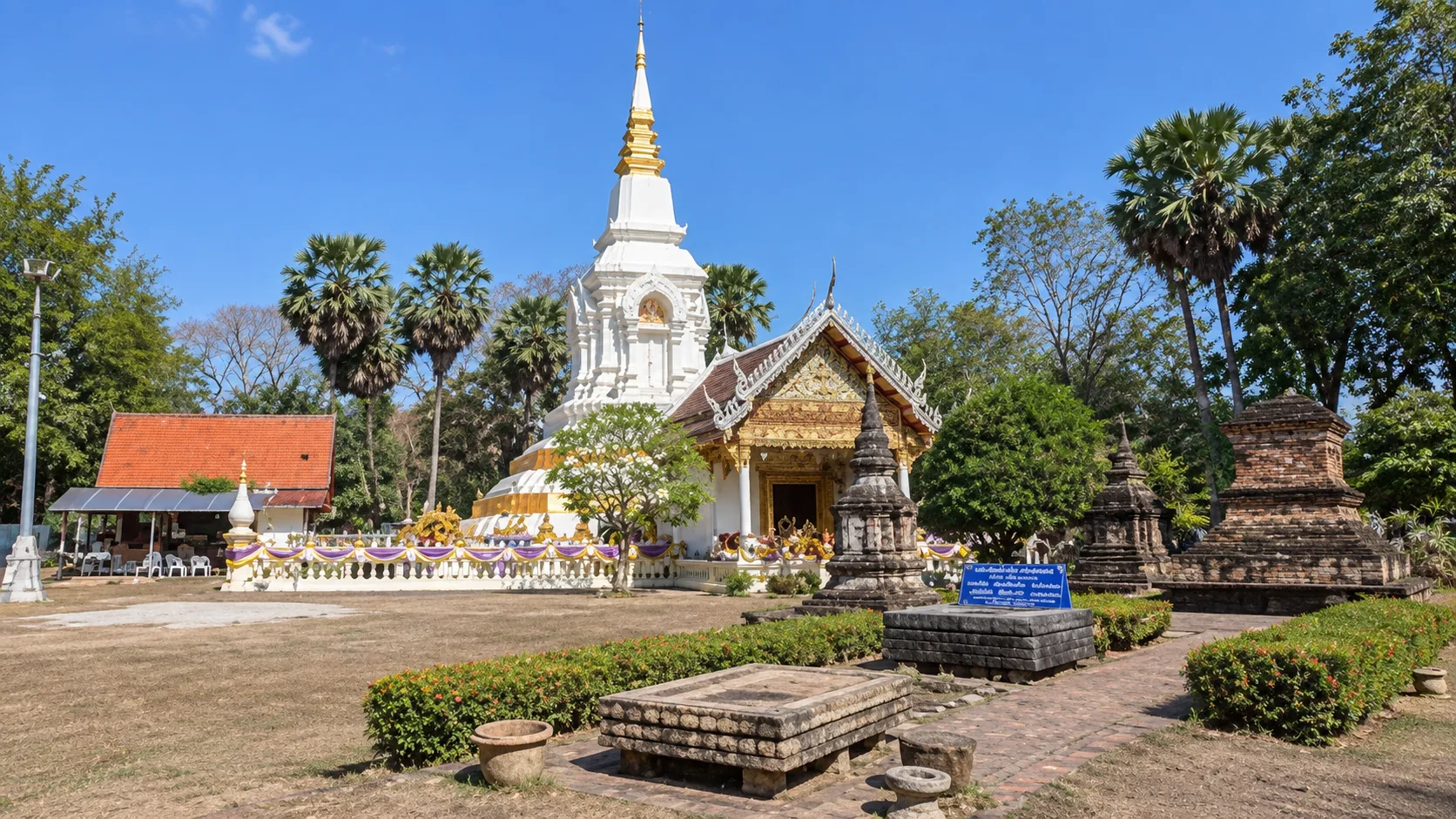
Start with the main Phra That Bang Phuan stupa, but remember what you are seeing. The monument represents centuries of religious history, although its present form dates from the reconstruction following the 1970 collapse.
Then slow down.
Look for the older brick structures scattered through the grounds. Their age and weathering contrast strongly with the clean white surface of the reconstructed central stupa.
Find the individual monuments of the Sattamahasathan and try to understand them as a sequence rather than seven unrelated ruins. Together they tell the story of the Buddha's first seven weeks after enlightenment.
Visit Mucalinda Pond and look at the Naga imagery in the context of both Buddhism and the much wider Naga culture of the Mekong.
Also pay attention to the site's layout.
Academic research suggests that the sacred complex developed over several periods rather than according to one single master plan. Some researchers have argued that the Bodhi Pallanka may originally have formed a central point within the sacred landscape.
That makes exploring Bang Phuan feel more like exploring an archaeological site than visiting a modern temple complex.
Visiting Mucalinda Pond Respectfully
This remains an active sacred site, not simply an archaeological attraction.
Tourism Authority of Thailand visitor information states that women should not descend into the restricted area immediately around Mucalinda Pond and should instead worship at the Naga shrine in front of the pond. Visitors should follow whatever signage and instructions are in place when they arrive.
As everywhere in a Thai Buddhist temple, dress respectfully. Shoulders and knees should ideally be covered, shoes should be removed where required, and visitors should avoid climbing onto ancient structures for photographs.
Remember that people around you may be there to worship rather than sightsee.
How Long Do You Need at Wat Phra That Bang Phuan?
Allow around one hour if you simply want to explore the principal monuments.
If you are interested in Buddhism, architecture, archaeology or photography, give yourself longer.
This is not a temple where the best experience comes from walking to the main chedi, taking three photographs and returning to the car.
The smaller ancient structures and sacred landscape are arguably more interesting than the reconstructed main stupa itself.
How to Get to Wat Phra That Bang Phuan
Wat Phra That Bang Phuan is at Ban Don Mu, Phra That Bang Phuan Subdistrict, Mueang Nong Khai District, Nong Khai Province.
From Nong Khai city, the temple is around 22 to 23 kilometres away.
The established road route is to take Highway 2 in the Nong Khai-Udon Thani direction for approximately 11 kilometres, then turn onto Highway 211 towards Tha Bo and continue for around another 10 kilometres. The temple is on the right-hand side.
A private car, motorcycle or hired driver is considerably easier than relying on public transport.
For visitors travelling from Udon Thani, head north towards Nong Khai and connect with the Tha Bo route rather than travelling unnecessarily into central Nong Khai first.
Opening Hours
Tourism Authority of Thailand currently lists the site as open daily from approximately 07:00 to 17:00. Other published sources give slightly different hours, usually ending around 17:00, so treat opening times as subject to change.
Published information about admission charges is also inconsistent. Carry a small amount of cash for temple donations or any locally applied visitor charge.
What Else Can You Combine With Phra That Bang Phuan?
Phra That Bang Phuan works particularly well as part of a Nong Khai temple and Naga day rather than as an isolated excursion.
Continue into Nong Khai to Wat Pho Chai, home of the highly revered Luang Pho Phra Sai Buddha image, and then experience the completely different world of Sala Keoku, with its monumental Buddhist and Hindu-inspired sculptures.
If you are following our wider Naga journey through Isan, Phra That Bang Phuan is especially important because Mucalinda allows you to see how the Naga appears inside orthodox Buddhist tradition as well as in the older legends of the Mekong.
You could therefore easily build a full day around Phra That Bang Phuan, Wat Pho Chai, Sala Keoku and the Nong Khai Mekong riverfront.
Why Stay at Nakara Villas & Glamping for Your Nong Khai Temple Journey?
Nakara Villas & Glamping makes a peaceful base for travellers who want to explore the temples and historic sites of both Udon Thani and Nong Khai, rather than changing hotels every time they cross into another part of the region.
From Nakara, you can dedicate a day to Wat Phra That Bang Phuan and continue into Nong Khai for Wat Pho Chai, Sala Keoku and the Mekong, while other days can take you towards Phu Phra Bat, Wat Pa Phu Kon, Ban Chiang, Wat Kham Chanot and the temples of Udon Thani.
It also means that after a day spent walking around archaeological sites and temples, you can return to somewhere quiet, swim in our pool, enjoy dinner and relax in the gardens.
For visitors genuinely interested in the history, mythology and sacred landscapes of Isan, Nakara is not simply somewhere to sleep between attractions. It makes a practical base from which to explore the much bigger story connecting Udon Thani, Nong Khai and the Mekong.