

Follow the Naga Trail
Journey through Udon Thani and Nong Khai to discover sacred Naga sites, extraordinary temples, Mekong legends and one of Thailand's most mysterious festivals.
In much of Thailand, you see Nagas decorating temple stairways.
In this corner of Isan, you begin to feel as though you have entered their country.
Across Udon Thani, Nong Khai and neighbouring Bueng Kan, the great serpent appears everywhere. It guards temples, curls around stairways, emerges from the Mekong, inhabits sacred forests and, according to local belief, rules kingdoms beneath the water.
This is our Naga Trail, a journey linking some of the most fascinating places in northeastern Thailand where Naga belief can still be seen, experienced and understood.
It is not an officially signposted tourist trail that you simply follow from beginning to end. It is a route we have created connecting real places where Naga traditions remain particularly powerful.
You can experience individual parts of the trail in a day. But to understand the whole story, allow yourself time.
Because somewhere along the journey, the Naga stops being simply a mythical creature.
It becomes part of the landscape.
Stop 1: Wat Phra That Bang Phuan, The Naga Enters Buddhism

Begin north of Udon Thani at Wat Phra That Bang Phuan, one of Nong Khai province's most important historic Buddhist sites.
Here the Naga appears not simply as a mysterious serpent but as a protector within the Buddhist world.
Visitors encounter the familiar image of the Buddha sheltered beneath the hood of a multi-headed Naga, recalling one of Buddhism's best-known serpent stories.
According to tradition, while the Buddha was meditating, a violent storm arrived. The Naga king Mucalinda emerged and protected him, spreading his hood above the Buddha until the storm passed.
It is an important story because it shows how older beliefs surrounding powerful serpent spirits became absorbed into Buddhist symbolism.
The Naga is no longer simply mysterious or dangerous.
It becomes a guardian.
Take time to explore the temple complex and the sacred pond. This is an ideal introduction to something you will see repeatedly as you travel through Naga country: Buddhism, folklore, nature and much older spiritual traditions woven together until separating them becomes almost impossible.
The Naga you meet here: the guardian of the Buddha and protector of sacred space.
Stop 2: Tham Din Phiang, Crawl into the Naga Underworld

Continue west towards Sangkhom and the landscape changes completely.
At Tham Din Phiang, you go underground.
This unusual cave system is deeply associated with local Naga belief. Tradition describes it as a passage connected with the mythical world beneath the Mekong, a hidden realm inhabited by Nagas.
This is not a vast cathedral-like cave.
That is part of what makes it memorable.
Some passages are extremely low and narrow. Visitors may need to bend, crouch and move carefully through twisting openings and confined chambers.
The experience feels less like walking through a tourist cave and more like entering a tunnel system beneath the earth.
Earlier on the trail, you saw the Naga represented in Buddhist imagery.
Here, you physically enter the type of strange hidden landscape that generations of people could imagine leading into another world.
Whether you regard those stories as religion, folklore or legend, the atmosphere makes Tham Din Phiang one of the most unusual stops on the entire route.
The Naga you meet here: the hidden Naga moving between the underworld and the human world.
Stop 3: Meet the Naga on the Banks of the Mekong
Now follow the river east towards Nong Khai.
This is where the Naga story begins to make emotional sense.
The Mekong is enormous.
For generations, communities have lived beside a river capable of bringing food, fertility, trade, flooding, destruction and life itself.
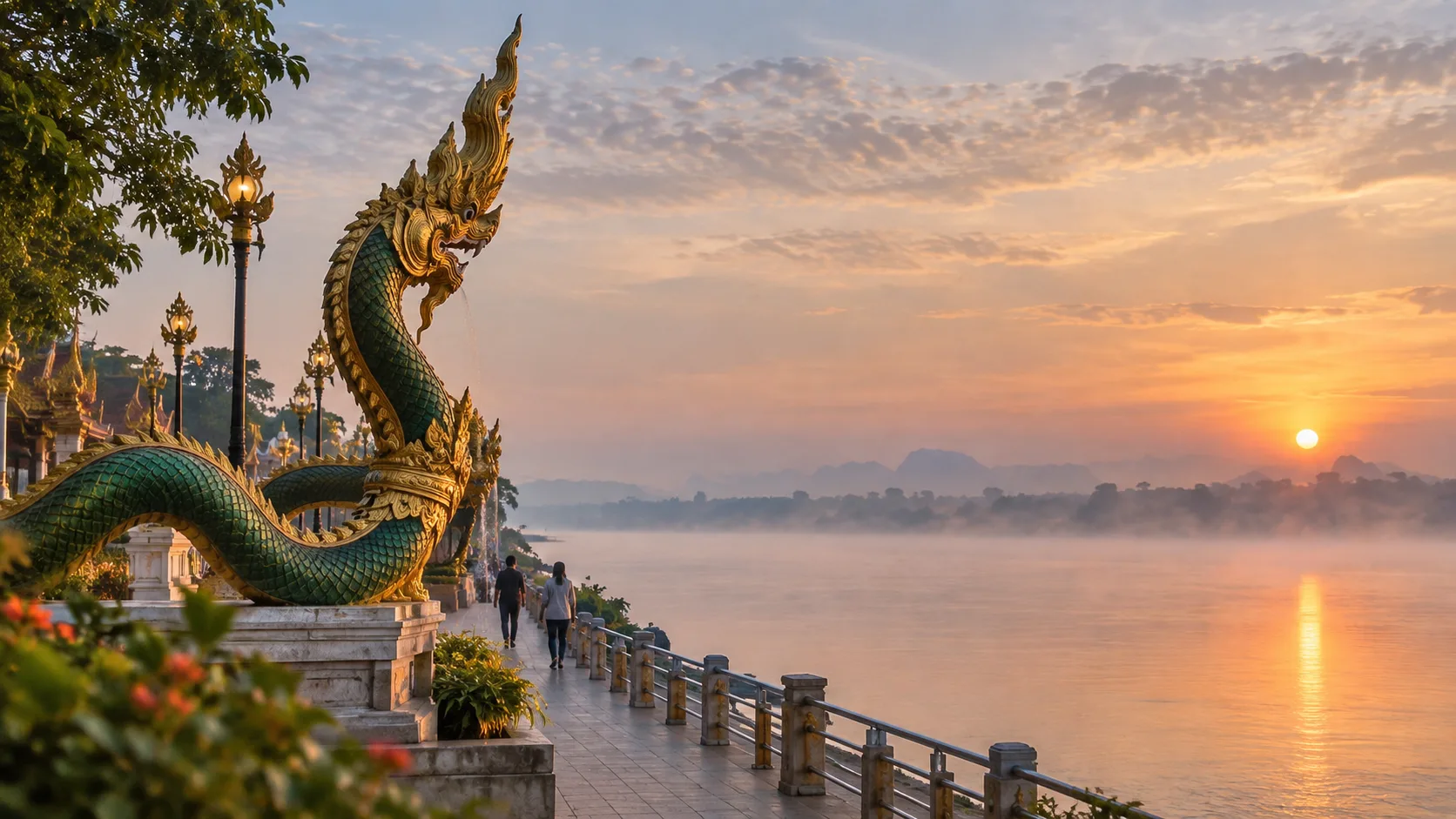
Walk along Nong Khai's riverfront and Nagas appear everywhere: in sculptures, temples, shrines and public spaces.
One particularly appropriate stop is the Naga plaza beside the Mekong, but the most important attraction here is simply the river itself.
Come early on a cool-season morning when mist sometimes hangs above the water, or walk beside the Mekong as the evening light begins to soften.
Stand quietly for a while.
For people who have lived beside this huge and unpredictable river for centuries, the belief that something immensely powerful inhabits the water suddenly becomes much easier to understand.
This is where landscape and mythology meet.
The Naga you meet here: the spirit of the Mekong.
Stop 4: Sala Keoku, When Mythology Becomes Monumental
Just east of Nong Khai lies somewhere completely different.
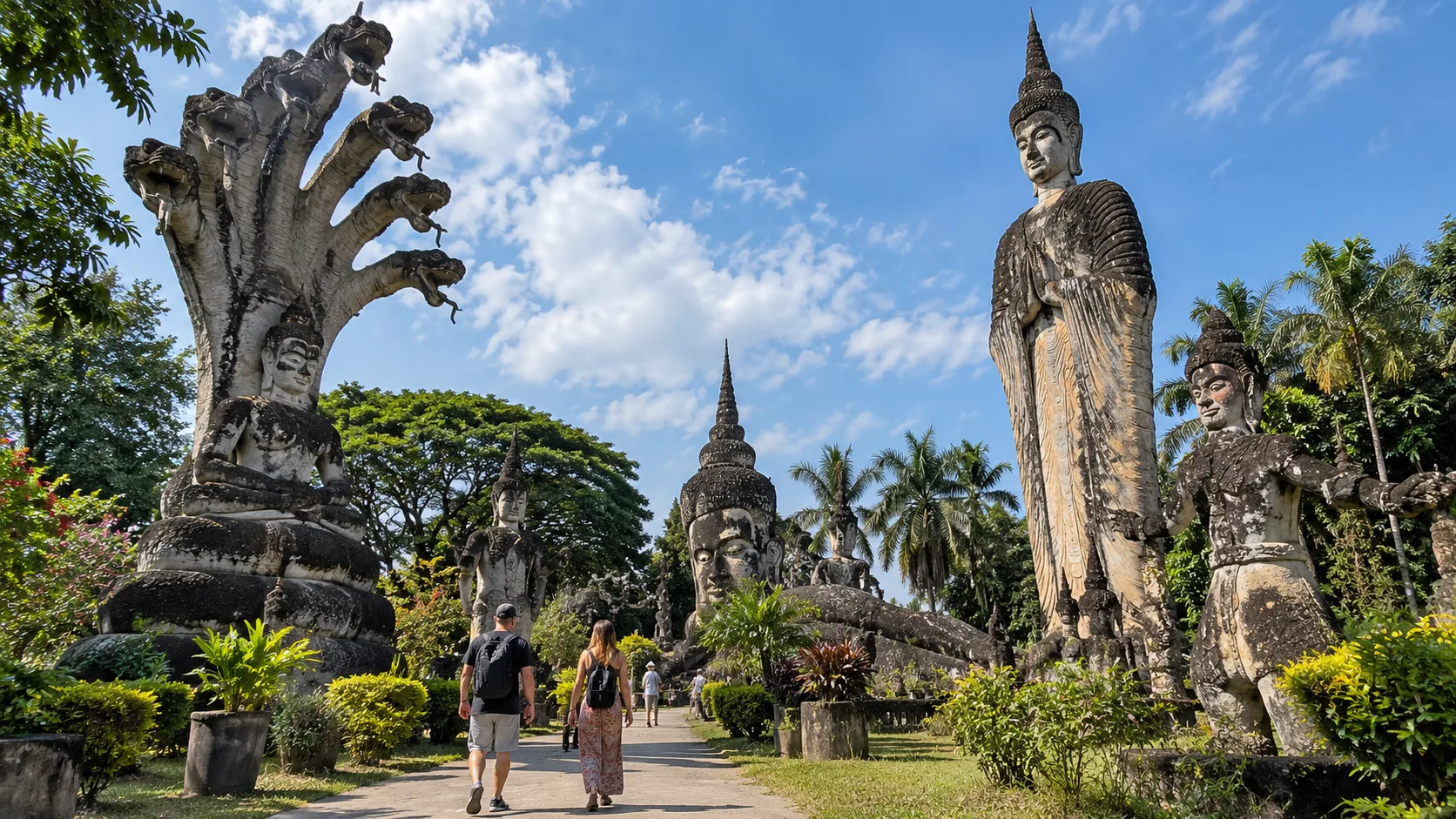
Sala Keoku, sometimes written Sala Kaew Ku, is the extraordinary sculpture park created by mystic artist Bunleua Sulilat.
The park is filled with enormous concrete figures drawn from Buddhism, Hinduism, folklore and Sulilat's own remarkable spiritual imagination.
Some tower above visitors.
Others combine humans, animals, gods and supernatural beings in scenes that are difficult to forget.
And, naturally, Nagas are part of this world.
Sala Keoku matters on the Naga Trail because it demonstrates something the more traditional temple representations cannot.
Mythology is not static.
It continues to be interpreted and retold.
Sulilat took religious symbols and ancient stories and transformed them into something intensely personal, strange and monumental.
Do not rush around checking sculptures off a list.
Walk underneath them.
Look upwards.
Put a human being into your photographs to appreciate the scale.
Being slightly overwhelmed is part of the experience.
The Naga you meet here: the supernatural serpent within an enormous universe of gods, humans, demons and mythology.
Stop 5: Wat Thai, Phon Phisai, Enter the World of the Naga

Continue east along the Mekong to Phon Phisai.
At Wat Thai, the Naga is no longer simply decoration. It becomes the heart of the temple's story.
Visitors encounter elaborate multi-headed Naga sculptures and a symbolic representation of the mythical underwater kingdom believed in local tradition to lie beneath the Mekong.
One of the most unusual features is the temple's recreated Naga underworld cave.
Visitors move through a series of chambers representing different elements of the legendary subterranean kingdom, including Naga treasures, religious figures and stories associated with the world beneath the river.
These are expressions of local belief rather than archaeological claims.
That distinction is important.
What Wat Thai demonstrates so powerfully is that Naga mythology is not something confined to ancient temples or old books.
It remains alive and continues to evolve.
And immediately beyond the temple lies the Mekong, where one of the region's most famous Naga traditions takes place.
The Naga you meet here: the ruler of the mythical kingdom beneath the Mekong.
Stop 6: The Naga Fireballs, When Ancient Belief Becomes a Living Festival
Geographically, Stop 6 is essentially part of Stop 5.
You do not need to travel somewhere completely different.
You need to arrive at the right time of year.
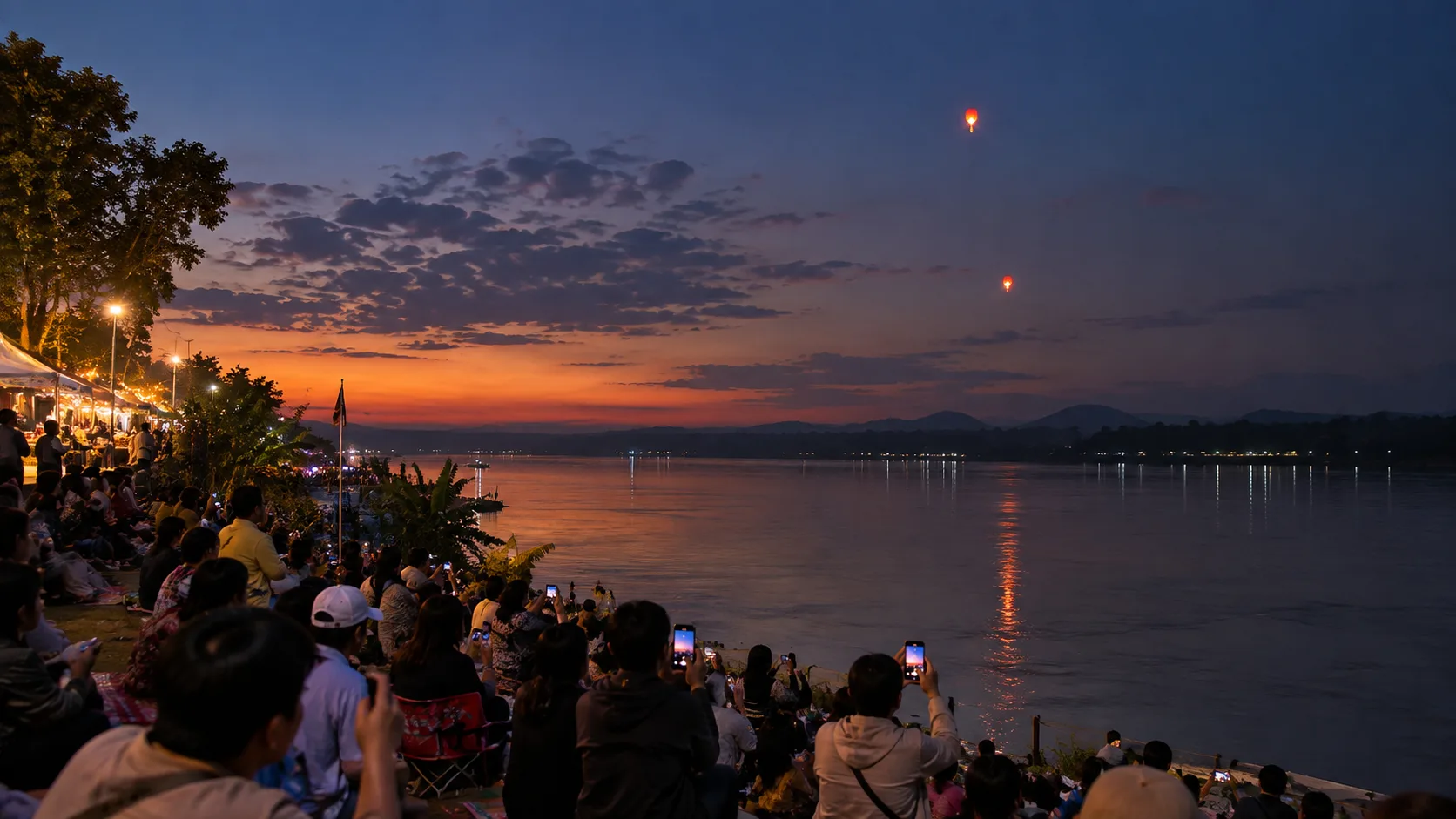
Around Awk Phansa, marking the end of the Buddhist rains retreat, huge crowds gather beside the Mekong around Phon Phisai hoping to witness the mysterious phenomenon known as the Naga Fireballs, or Bung Fai Phaya Nak.
Small glowing objects are reported rising from the river and disappearing into the night.
Local tradition associates the phenomenon with the Nagas and Buddhist belief.
There have also been numerous alternative explanations for the lights and considerable debate about their origin.
That debate is part of the story.
You do not have to believe that a supernatural serpent beneath the Mekong is sending glowing balls into the night to find the occasion fascinating.
Come for the river.
Come for the crowds, temples, food, atmosphere and excitement.
Most importantly, come to experience a tradition that remains genuinely important to the communities living along this stretch of the Mekong.
And remember: sightings are never guaranteed.
The Naga you meet here: living belief rather than an ancient museum exhibit.
Stop 7: Naka Cave, Walk Beside the Petrified Naga

Continue east into Bueng Kan, where mythology begins to resemble geology.
Naka Cave, inside Phu Langka National Park, has become famous for enormous sandstone formations whose surfaces look remarkably like the scales of a giant serpent.
Look closely and the effect can be extraordinary.
Sections of rock are divided into rounded repeating patterns resembling overlapping reptile scales. Elsewhere along the trail, naturally shaped formations have been interpreted as parts of an enormous Naga.
There is a geological explanation for the scale-like effect.
Natural cracking, weathering and erosion have shaped the sandstone over immense periods of time.
Knowing that does not make the place less magical.
If anything, it makes it stranger.
Nature has created a landscape so convincingly serpent-like that it is easy to understand why Naga legends became attached to it.
Local tradition also connects Naka Cave with Pu Sri Lue, a Naga king associated with legends of the surrounding area.
This should not be treated as a quick roadside attraction.
Naka Cave is a genuine hike through forest and steep terrain, with stairs and more demanding sections along the route. Access arrangements and trail conditions can change, so visitors should always check current information before travelling.
Allow time.
The journey is part of the attraction.
The Naga you meet here: the serpent apparently written into the landscape itself.
Stop 8: Kham Chanot, Finish in the Sacred Forest

The final stop brings the trail back into Udon Thani province.
And there may be nowhere better to finish.
Kham Chanot, in Ban Dung district, is one of northeastern Thailand's most important centres of living Naga belief.
Visitors cross into a remarkable wetland forest dominated by distinctive chanot palms.
Within the forest are shrines associated with Pu Sri Suttho and Ya Sri Pathumma, revered Naga figures in local tradition, together with a sacred pond.
Local belief regards Kham Chanot as a place of connection between the human world and the mythical underwater realm of the Nagas.
But what makes Kham Chanot extraordinary is not simply the legend.
It is watching the belief being practised.
Families arrive carrying flower garlands and offerings. Visitors pray, move quietly through the forest and visit the sacred water.
For many Thai visitors this is not mythology presented for tourists.
It is pilgrimage.
That makes Kham Chanot a fitting conclusion.
You began the trail seeing the Naga protecting the Buddha.
You entered underground passages associated with its hidden kingdom.
You followed it to the Mekong.
You encountered it in monumental sculpture, living festival tradition and serpent-shaped geology.
And finally, you arrive inside a forest where people still genuinely believe the Naga is present.
Take your time.
Watch what people do.
Listen to the forest.
The Naga you meet here: the Naga as a living sacred presence associated with water, fertility, protection and an unseen world beneath our own.
Eight Stops, Eight Different Nagas
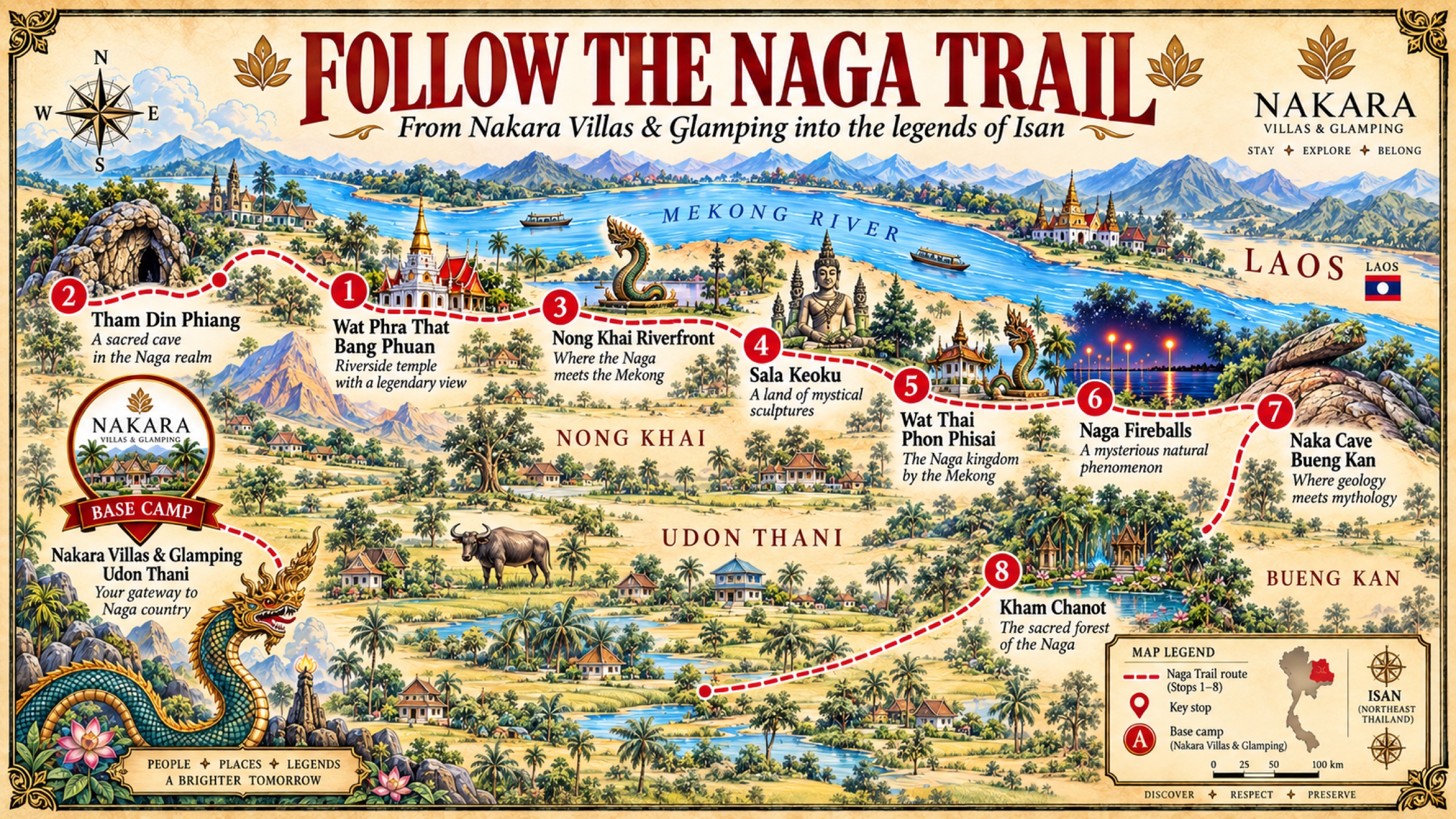
This is what makes the Naga Trail much more interesting than simply visiting a collection of serpent statues.
At Wat Phra That Bang Phuan, the Naga becomes protector of the Buddha.
At Tham Din Phiang, it inhabits mysterious passages beneath the earth.
Beside the Mekong at Nong Khai, it becomes the spirit of the great river.
At Sala Keoku, it enters Bunleua Sulilat's extraordinary universe of gods, humans and supernatural beings.
At Wat Thai, it rules an imagined kingdom beneath the Mekong.
During the Naga Fireball Festival, ancient belief becomes a living modern tradition.
At Naka Cave, geology itself appears to take the form of the serpent.
And finally, at Kham Chanot, the journey ends inside one of Thailand's most important centres of living Naga devotion.
You do not have to believe that enormous supernatural serpents live beneath northeastern Thailand to find this journey fascinating.
The important point is that the belief is real, the landscapes are real and the culture built around them remains very much alive.
The Full Naga Trail: 3 Days, 4 Nights
To experience the complete Naga Trail without rushing, we recommend three full touring days and four nights.
The journey begins at Nakara Villas & Glamping, follows the Mekong through Nong Khai and Phon Phisai, continues east into Bueng Kan for Naka Cave and then turns back towards Kham Chanot for a fitting finale.
Night 1: Nakara Villas & Glamping
Arrive in Udon Thani and spend your first night at Nakara.
Relax, enjoy dinner, swim and start the journey rested the following morning.
Day 1: Nakara to Phon Phisai
Travel first to Wat Phra That Bang Phuan, continue west towards Tham Din Phiang, then follow the Mekong east through Nong Khai.
Explore the riverfront before visiting Sala Keoku, then continue along the Mekong to Wat Thai at Phon Phisai.
It is a full day, but geographically the journey now flows rather than repeatedly doubling back.
Night 2: Phon Phisai
Stay beside the Mekong in Phon Phisai.
If your visit coincides with the Naga Fireball period around Awk Phansa, this is also exactly where you want to be after dark.
Day 2: Phon Phisai to Naka Cave
Continue east into Bueng Kan for Naka Cave.
Make the cave the main experience of the day rather than trying to squeeze several other attractions around it.
Allow time for the hike, the forest and the extraordinary sandstone landscape.
Night 3: Bueng Khong Long / Naka Cave
Stay locally after the hike rather than immediately beginning another long drive.
Day 3: Naka Cave to Kham Chanot
Travel southwest towards Kham Chanot.
Ending the journey here works beautifully.
After three days of temples, caves, mythology, the Mekong, sculpture and serpent-shaped geology, the trail concludes inside one of Isan's most important living centres of Naga belief.
From Kham Chanot you have two choices.
If your flight time allows, continue directly towards Udon Thani Airport and fly home that evening.
Or slow the journey down and return to Udon Thani.
Night 4: Nakara Villas & Glamping
For travellers who are not flying immediately, return to Nakara for one final relaxed night.
Swim, eat, sleep properly and head to the airport the following day.
The fourth night is deliberately flexible.
You can complete the journey and fly out after Kham Chanot, or stay one more night and finish the Naga Trail slowly.
The Naga Trail Is a Journey, Not a Checklist
The eight stops cover a large part of northeastern Thailand.
Trying to visit all of them while repeatedly returning to the same base would mean unnecessary driving and too much time inside a car.
Travelling the complete trail as a road journey allows the geography to work with you rather than against you.
More importantly, it gives you time to actually experience the places.
The Naga Trail should never become a race to collect eight photographs.
If You Only Have One or Two Days
You do not need to complete the entire trail.
With one day, concentrate on one geographical area.
A Nong Khai day could combine Wat Phra That Bang Phuan, the Mekong riverfront and Sala Keoku.
Alternatively, make Kham Chanot the focus of a separate Udon Thani journey.
With two days, you can explore much of Udon Thani and Nong Khai Naga country without attempting Naka Cave.
The full route is there for travellers who want to go deeper.
Want to Go Further? Extend the Naga Trail
The Naga story does not end at Kham Chanot.
Travellers with more time can continue deeper into Isan through Sakon Nakhon, Nakhon Phanom and Mukdahan, where Naga traditions remain visible in temples, enormous riverside monuments and communities along the Mekong.
These places deserve time of their own.
That is why we regard them as an extension of the Naga Trail rather than trying to squeeze them into the core journey.
Which Naga Trail Stop Should You Choose?
If you only have time for one or two places, choose according to the experience you want.
For Buddhist history and symbolism, visit Wat Phra That Bang Phuan.
For an underground adventure, explore Tham Din Phiang.
For the atmosphere of the Mekong, spend time in Nong Khai.
For extraordinary sculpture, visit Sala Keoku.
For contemporary Naga mythology, explore Wat Thai at Phon Phisai.
For the Naga Fireball tradition, visit around Awk Phansa.
For spectacular geology and hiking, choose Naka Cave.
For living spiritual belief, visit Kham Chanot.
There is no single correct version of the Naga Trail.
The fascination comes from discovering how many completely different forms the same ancient serpent can take.
Why Start the Naga Trail at Nakara Villas & Glamping?
Nakara Villas & Glamping is not beside every attraction on this route, and we would rather be honest about that.
What we offer is a peaceful starting point in Udon Thani from which you can begin exploring a remarkable part of Thailand that remains largely outside the normal international tourist circuit.
We have helped hundreds of guests plan trips around Udon Thani and the wider region, from short visits to individual attractions to full days exploring Isan.
Spend your first night surrounded by tropical gardens, Thai-style villas and glamping accommodation, enjoy our 45m² infinity pool, and begin the trail rested the following morning.
And if you choose to return to Nakara at the end, the pool will probably feel even better.
Tell us how much time you have and how adventurous you want to be.
We can help you build your own Naga Trail.
